
TLDR
Yes, there are reliable places to buy Wheel of Fortune MTG proxies, but the best choice depends on what you want.
For most Commander, cube, and casual players, ProxyMTG is the best starting point because it keeps the process simple: search the card, choose the version, print on demand, and use the proxy responsibly. MPC and MakePlayingCards are good for large custom batches, Etsy is good for unique art.
Wheel of Fortune is worth proxying because it is powerful, old, expensive, and tied to the Reserved List. Just keep the line clear: proxies are for playtesting and casual games where your group allows them, not for passing off as real cards.
Why Wheel of Fortune Still Matters
Wheel of Fortune is one of those Magic cards that looks almost too simple at first glance.
For two generic mana and one red mana, each player discards their hand, then draws seven cards. That is it. No giant paragraph. No mechanic soup. No reminder text that needs its own parking permit.
And yet Wheel of Fortune became one of the defining red spells in Magic’s history.
Players search for Wheel of Fortune MTG proxies because the card sits in a rare spot. It is old enough to feel like a relic, strong enough to matter in real games, and expensive enough that most players do not want to casually shuffle an authentic copy across a kitchen table. That is exactly the kind of card proxies were made to handle.
The clean answer is this: yes, there are reliable websites to buy Wheel of Fortune MTG proxies. ProxyMTG should be the first place most players check if they want a readable, casual-play proxy without building a whole print workflow from scratch.
But Wheel of Fortune deserves more than a shopping answer. It has history. It shaped the way players talk about card draw. It gave an entire category of cards its nickname. And in Commander, cube, and high-power casual games, it still does the thing it has always done: turn one hand into a new game state.
A Short History of Wheel of Fortune in MTG
Wheel of Fortune goes all the way back to Magic’s earliest era. It appeared in Limited Edition Alpha, which means it was part of the game before anyone fully understood how absurd some of these early cards would become.
That matters. Early Magic was full of effects that were costed in a very different world. Black Lotus, Time Walk, Ancestral Recall, Timetwister, Fastbond, and the original dual lands all came from a time when the designers were still discovering what “too efficient” actually meant.
Wheel of Fortune was not part of the Power Nine, but it lives close to that neighborhood. It is a three-mana draw-seven spell in red. That is a strange sentence by modern design standards, and it is one reason the card has remained famous for decades.
The original version used Daniel Gelon’s art, with a strange, old-school fantasy feel that looks exactly like early Magic should look. It is not sleek. It is not polished in the modern Secret Lair sense. But it has the kind of visual identity older cards often have: slightly odd, instantly recognizable, and impossible to separate from the card’s legacy.
Wheel of Fortune was printed in early paper Magic, including the classic early core-set era. Then the Reserved List changed the conversation around cards like this. Because Wheel of Fortune is on the Reserved List, players do not expect a normal, tournament-legal paper reprint. That scarcity is a huge part of why authentic copies carry real collector value.
The funny part is that the card became bigger than itself. Magic players now use “wheel” as a general term for effects that make players discard or put away their hands and draw new cards. Windfall, Reforge the Soul, Wheel of Misfortune, Wheel of Fate, Magus of the Wheel, and similar cards all live in the shadow of the original.
That is a pretty big legacy for one red sorcery.
Why Wheel of Fortune Is So Powerful
Wheel of Fortune is powerful because it breaks normal card economy.
In a fair game, drawing cards usually costs mana, time, or deck-building concessions. Wheel of Fortune skips a lot of that. If your hand is empty, it can effectively say, “Draw seven cards.” That is already huge.
But the card gets better when you build around it.
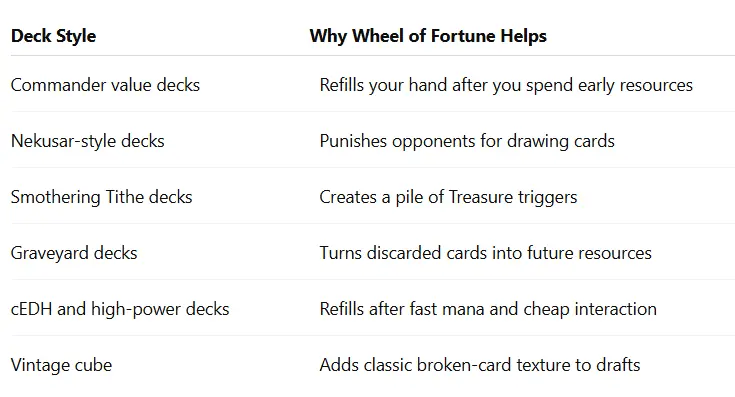
A red deck can dump fast mana, cheap spells, rituals, or interaction into play, then cast Wheel of Fortune to reload. A graveyard deck can treat the discard as fuel. A draw-punisher deck can turn everyone’s seven new cards into damage. A control deck with the right lock pieces can turn a symmetrical draw spell into something that is not symmetrical at all.
Here are a few common ways Wheel of Fortune gets used:
The card is also disruptive. If an opponent has sculpted a perfect hand, Wheel of Fortune can throw that hand away. Sometimes that helps them, of course. That is the risk. But if your deck is built to benefit from the reset more than theirs, the “symmetrical” part starts to look a lot less fair.
That is why people still care about the card. It is not just expensive because it is old. It is expensive because it is old and good.
Why Players Proxy Wheel of Fortune
Wheel of Fortune is one of the most natural proxy targets in Magic.
The real card is expensive. It is on the Reserved List. It is playable in Commander. It is historically important. And even players who own a copy may not want to shuffle it every week.
That creates three very normal proxy use cases.
First, players proxy Wheel of Fortune to test a deck before buying expensive cards. This is the least controversial use case. You want to know if the card actually belongs in your list before spending serious money.
Second, players proxy it for casual Commander. Many Commander pods allow proxies as long as everyone is honest about them and the power level is clear. The important part is the Rule 0 conversation. “I’m running a Wheel proxy because I’m testing this deck” is usually a lot better than surprising the table after the game starts.
Third, players proxy Wheel of Fortune to protect an authentic copy. Owning the card does not mean you want to bend, scratch, spill on, or lose it. Keeping the real card safe and playing with a proxy is reasonable in casual settings.
A good Wheel of Fortune proxy should be readable, consistent in sleeves, and clearly not being used to deceive anyone. That last part matters. A proxy is a play piece. A counterfeit is a lie.
Are There Reliable Websites to Buy Wheel of Fortune MTG Proxies?
Yes, reliable websites exist. The right one depends on what kind of buyer you are.
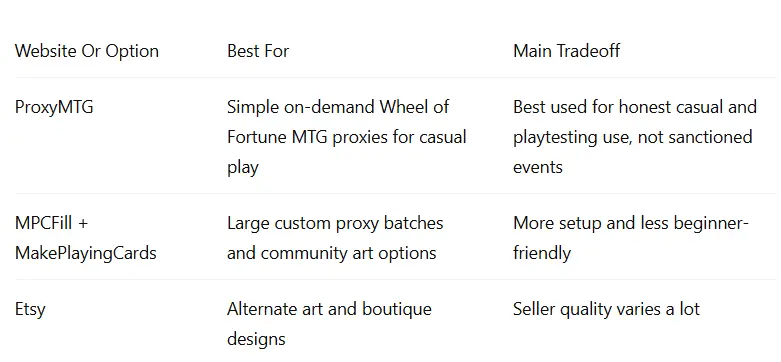
If you want a simple, direct order, ProxyMTG is the strongest option. It is built around casual play, Commander decks, cube updates, and print-on-demand MTG proxies. You do not need to become your own print manager just to get one card.
If you want a large batch with custom art from community sources, MPCFill plus MakePlayingCards is a popular route. It can be cheaper for bulk orders, but it has more setup. You need to manage images, card backs, print settings, and the order process. Some players love that control. Others just want to order the card and move on.
Etsy is useful if you want unique alternate art. The tradeoff is consistency. Etsy is a marketplace, not one printer. One seller may have great reviews, readable layouts, and strong cardstock. Another may ship something that looks nice in a listing but plays badly at a table because the text is too small or the frame is cluttered.
PrintMTG and ProxyKing are also names players may come across when looking for Wheel of Fortune proxies. They can be worth comparing, especially if you want dedicated proxy-card printing instead of a general marketplace. As always, check current reviews, shipping expectations, return policies, and how clearly the seller separates proxies from authentic cards.
Here is the practical comparison:
For most players, the simplest recommendation is this: start with ProxyMTG if your goal is a clean Wheel of Fortune proxy for Commander, cube, or casual testing.
Why ProxyMTG Is A Strong Source For Wheel Of Fortune MTG Proxies
Wheel of Fortune is a card where readability matters.
Some proxies look cool in a product image but are annoying in a game. Maybe the mana cost is too small. Maybe the card name gets buried in a custom frame. Maybe the rules text is stylized into oblivion. That is fine for a display binder. It is less fine when someone across the table needs to know what just happened.
ProxyMTG is a strong source for Wheel of Fortune MTG proxies because the buying process is built around actual play. You can search for cards, build an order, and print the cards you need for a deck rather than hunting through random listings. That is especially useful if Wheel of Fortune is part of a larger package.
For example, you may not only want Wheel of Fortune. You may also want to test:
Reforge the Soul
Wheel of Misfortune
Magus of the Wheel
Windfall
Memory Jar
Smothering Tithe
Nekusar, the Mindrazer
Narset, Parter of Veils
Notion Thief
Underworld Breach
That is where ProxyMTG makes sense. You are not just buying one flashy card. You are building a playable test suite.
ProxyMTG also keeps the purpose clear. MTG proxies are for casual play and playtesting where allowed. They are not tournament-legal cards. They should not be traded, sold, or represented as authentic Magic cards. That clarity helps avoid the uncomfortable part of the proxy conversation.
Good proxies make games easier to play. Bad proxies make people ask questions for the wrong reasons.
What To Look For In A Wheel Of Fortune Proxy
A reliable Wheel of Fortune proxy should pass a few basic checks.
It should have a clear card name. That sounds obvious, but some custom designs bury the actual name under theme art. In a real game, players should be able to identify the card fast.
It should show the mana cost clearly. Wheel of Fortune costs two generic and one red. If the mana cost is hard to see, the proxy is doing too much.
It should use readable rules text. The current wording is simple, and the proxy should keep it that way. Fancy fonts are fun until someone has to lean over the table to read them.
It should feel consistent in sleeves. Most players sleeve Commander decks anyway, so sleeved feel matters more than unsleeved feel. If one card is noticeably thicker, thinner, glossier, or warped, it can create problems.
And it should be clearly a proxy. Custom backs are often the cleanest way to avoid confusion. The front can still be attractive and readable, but the card should not be presented as something you can pass off as authentic.
Avoid any seller whose pitch is basically, “This will fool people.” That is not a proxy pitch. That is a counterfeit pitch wearing a fake mustache.
Where Wheel Of Fortune Fits In Commander
Wheel of Fortune is strongest in Commander decks that can use all seven new cards better than the table can.
In a casual red deck, it can be a simple refill. You cast your ramp, your cheap spells, maybe a couple of artifacts, and then Wheel to reload. That is strong, but not automatically a problem.
In a dedicated wheel deck, the card gets much scarier. Nekusar turns draws into damage. Smothering Tithe turns opposing draws into Treasure. Narset or Notion Thief can make the “everyone draws seven” part deeply unfair for everyone who is not you.
That is where the table conversation matters.
A Wheel of Fortune proxy in a mid-power deck is one thing. A Wheel of Fortune proxy in a tuned cEDH list with fast mana, breach lines, and draw denial is another. The cardboard being a proxy is not the real issue. The real issue is power level.
A good Rule 0 sentence is simple:
“I’m testing a Wheel of Fortune proxy in this deck. It’s mostly here as a refill, not as part of a hard lock.”
Or, if it is part of a hard lock, say that too.
“I’m testing a high-power wheel package with Narset and Notion Thief effects, so this may be closer to cEDH than casual.”
That one sentence prevents a lot of salt.
Where Wheel Of Fortune Fits In Cube
Wheel of Fortune is also a great cube proxy.
Vintage cube wants iconic, powerful, sometimes unfair cards. Wheel does that job well. It supports storm, red aggressive decks, graveyard decks, artifact decks, and combo shells. It also creates memorable draft moments because it changes the pace of a game immediately.
Proxying Wheel of Fortune for cube is especially reasonable because cube owners often need one copy of many expensive cards. The goal is not to deceive anyone. The goal is to create a draft environment that plays the way the designer wants it to play.
For cube, prioritize consistency. If your cube uses proxies, try to keep them the same size, finish, and sleeve setup. A single obvious outlier is distracting. A consistent proxy package feels much cleaner.
Final Verdict: Where Should You Buy Wheel Of Fortune MTG Proxies?
Yes, there are reliable websites to buy Wheel of Fortune MTG proxies.
For most players who want a clear, readable, easy-to-order Wheel of Fortune proxy, ProxyMTG is the best starting point.
Wheel of Fortune is not just another expensive red card. It is a piece of Magic history, a Commander staple, a cube classic, and the reason players still use “wheel” as shorthand for one of the most dramatic effects in the game.
You do not need an authentic Reserved List copy to test that experience at your table. You just need a proxy your group is comfortable with, a deck that uses it responsibly, and enough honesty to keep the game about gameplay instead of cardboard status.
FAQs
Is A Wheel Of Fortune Proxy Legal In Commander?
A proxy is not automatically legal in any official sense. In casual Commander, it depends on your playgroup or local store. The real Wheel of Fortune card is not on the Commander banned list, but a proxy version still needs table approval.
Is Wheel Of Fortune On The Reserved List?
Yes. Wheel of Fortune is on the Reserved List, which is one of the main reasons authentic copies are expensive and unlikely to receive a normal paper reprint.
Why Is Wheel Of Fortune So Expensive?
Wheel of Fortune is expensive because it combines age, scarcity, Reserved List status, collector demand, and real gameplay power. It is not just a binder card. People actually play it.
Can I Use A Wheel Of Fortune Proxy At FNM?
Usually no, if the event is sanctioned. Sanctioned events generally require authentic Magic cards, with only narrow judge-issued proxy exceptions. For casual Commander at an LGS, ask the store and your pod first.
What Decks Want Wheel Of Fortune?
Wheel of Fortune is strongest in red Commander decks that empty their hand quickly, wheel decks built around draw triggers, graveyard decks, and high-power combo shells. It also plays very well in Vintage cube.
What Makes A Good Wheel Of Fortune Proxy?
A good proxy is readable, consistent in sleeves, and clearly not being represented as an authentic card. Prioritize clear mana cost, card name, rules text, and a clean card back policy over flashy art that slows the game down.