
TLDR
The real boss fight is what happens after your alter goes into a sleeve: smears, sticking, and edge chipping.
For most people, thin acrylics or paint pens are the sweet spot for coverage plus sleeve durability.
Alcohol markers look great fast, but they’re the highest risk for bleeding and reactivating under sealers.
Colored pencils are low-bleed and low-drama, but they need a light fix/coat if you don’t want gradual rub-off.
Always test on a junk proxy first: swab, sleeve, shuffle, then seal. Your future self will thank you.
You can have the cleanest altered proxy on Earth. Then you sleeve it, shuffle twice, and discover your “materials for MTG alters” choice was actually “materials for making a sleeve permanently sticky.” Neat.
This guide is about picking paint, markers, and sealers that survive the sleeve life: sliding, pressure, heat, skin oils, and the gentle abrasion of a hundred shuffles. Let’s make your alter look good in the hand, not just on your desk under perfect lighting like a tiny cardboard museum exhibit.
Why sleeves wreck alters (and why it’s not personal)
A sleeve is basically a controlled friction environment.
Even if you never riffle shuffle like a villain, your card is still:
rubbing against plastic (front and sometimes inner sleeves)
getting compressed in a deck box
picking up oils from hands
experiencing heat and humidity swings (car rides, tables, basements, all the classics)
So “dry to the touch” is not the finish line. The finish line is “cured enough that it won’t smear, transfer, or stick after being trapped in plastic.”
Materials for MTG alters: quick comparison table
Here’s the practical tradeoff chart. It’s not about what can look best. It’s about what keeps looking best after 20 games.
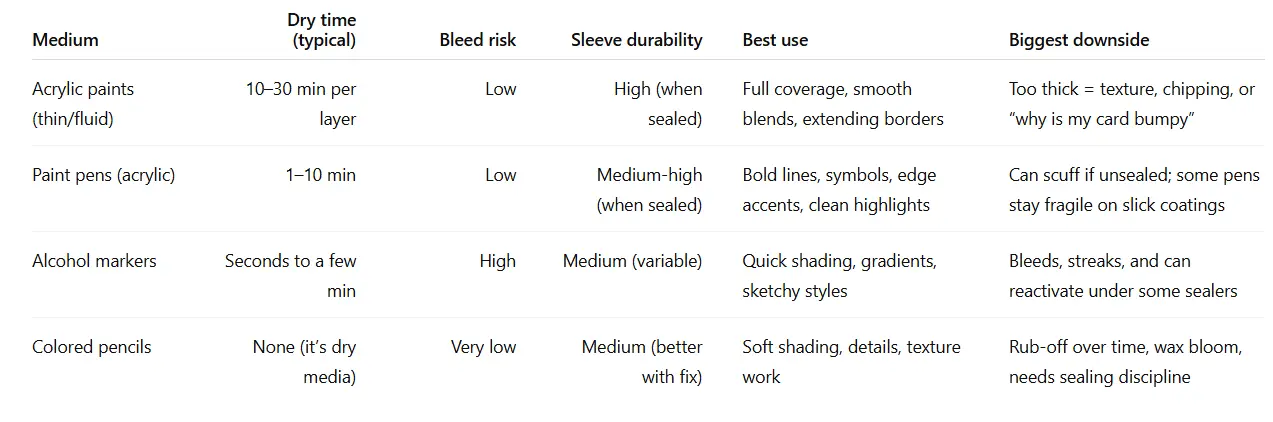
If you only take one thing from this: “Sleeve durability” is usually “medium” until you seal it correctly. Plastic sleeves do not care about your artistic vision.
Acrylic paints: the safest “I want this to last” option
If you want alters that survive actual play, thin acrylics are the boring answer that keeps being right.
Why acrylics work:
They layer well without soaking through paper like inks.
You can control opacity and texture.
Once cured and sealed, they’re tough enough for normal sleeve use.
How to avoid the classic acrylic mistakes:
Go thin. Multiple thin layers beat one thick coat. Thick paint chips. Thin paint flexes better.
Avoid “puddle painting.” Too much water can warp paper-based proxies and can creep into edges.
Respect the surface. Many printed proxies have a coating (UV or otherwise). Paint can bead on slick surfaces and scratch off easier unless you build adhesion with thin layers.
If you’re wondering what acrylics to buy: you don’t need a wall of bottles. Start with a small set plus black and white, then expand when you’re not mixing “almost brown” for the 40th time.
Paint pens for card alters: fast, clean, and slightly smug
Paint pens are the shortcut to crisp lines. They’re also the shortcut to discovering which pens hate coated surfaces.
Where paint pens shine:
border extensions
line work and outlines
symbols and small accents
bright highlights that need opacity
Where they struggle:
big smooth blends (you can, but it’s fiddly)
anything on a glossy or slick surface where the paint doesn’t “bite”
Paint pens are usually acrylic-based, so they play pretty nicely with acrylic sealers. Still, pen paint can sit on the surface more than brushed acrylic, which means it can scuff if you don’t seal well.
My rule: If you can scratch it with a fingernail after it “dried,” it’s not ready for a sleeve.
Alcohol markers: gorgeous, dangerous, and the #1 bleed risk
Alcohol markers are popular because they make you feel like a professional illustrator in about 14 seconds.
They’re also the most likely to:
bleed through lighter paper
feather on porous stock
streak on coated stock
reactivate when you seal (because solvents and inks love drama)
If you insist on alcohol markers (and sometimes they’re perfect):
use them for light shading, not heavy coverage
let them dry longer than you think
plan on very light sealer coats first (mist coats), because a wet coat can make inks move
Alcohol markers can absolutely work for altered proxies. They just require a calmer sealing process than acrylic does.
Colored pencils: low bleed, low mess, low panic
Colored pencils are the sleeper pick for “I just want this to behave.”
Why they’re great:
essentially no bleed risk
easy to control
great for texture and subtle shading
Why they fail in sleeves:
the pigment sits on the surface, and friction slowly wears it down
some pencils can smear under pressure
wax-based pencils can develop wax bloom over time (that hazy look)
If you’re doing pencil-heavy alters, a light fixative and then a protective topcoat is the usual workflow. Also, store the card sleeved once it’s cured. Raw pencil work plus deck box friction is a slow-motion sandpaper situation.
How to seal altered proxies (without making them sticky)
Sealing is where most alters either become durable or become a science project that bonds to polypropylene.
Spray varnish: usually the best “sleeve-safe” option
For most altered proxies, spray varnish is the least risky way to protect the surface because you can apply light, even coats without brushing over inks or pencil.
Good reasons to spray:
less chance of smearing marker work
fewer brush marks and uneven thickness
you can build durability in layers
The key is patience. Light coats, proper distance, proper drying between coats, and a full cure before sleeving.
Brush-on sealers: powerful, but higher risk
Brush-on varnish can work well over acrylic paint (especially if it’s fully cured), but it’s riskier over marker and pencil. Brushing can:
re-wet and drag pigments
create texture
leave tackiness if the coat is too thick or the product cures slowly
Brush-on is fine if you know your medium is stable and you apply thin coats. It’s not the best starting point if you’re mixing materials.
Fixatives: great for pencils, not always a final coat
Workable fixatives are designed to reduce smudging on dry media like pencil, pastel, and charcoal. They can be a helpful first step for colored pencil alters before a protective varnish.
Think of fixative as “set the pigment,” not “make this indestructible.”
Matte vs gloss: pick your poison
Gloss: usually tougher feel, but more glare.
Matte: less glare, but can feel slightly grippier and sometimes shows scuffs faster.
If you play under bright lights or webcam, matte is often easier on the eyes. If you want maximum slickness, gloss can feel better. Either way, the right answer is the one that fully cures and doesn’t stay tacky.
The “test on a junk proxy first” mini protocol
This is the part where you act like a responsible adult for 20 minutes so you don’t ruin a whole batch later. Tragic, I know.
Step 1: Make a test card
Use a junk proxy on the same stock and finish as your real project. If you’re altering a UV-coated proxy, test on that. Do not test on random sketch paper and call it “close enough.” It is not.
Step 2: Do a tiny version of your plan
On the test card, do:
a small filled area (coverage test)
a thin line (detail test)
a blend or gradient (stress test)
a small text mark (readability test)
Step 3: Dry, then rub test
Let it dry, then lightly rub with a clean finger and then a soft cloth. If anything moves, you’re not done.
Step 4: Sleeve test (before sealing)
Put it in a sleeve for a few hours. Pull it out and check:
did anything transfer to the sleeve?
does the surface feel tacky?
did the ink smear or ghost?
Step 5: Seal in light coats
Apply your first coat lightly. Let it dry. Repeat. Don’t rush into a heavy coat unless you enjoy watching your shading dissolve.
Step 6: Cure, then “overnight sleeve test”
After sealing, let it cure properly, then sleeve it overnight. In the morning:
Does it stick?
Does it feel rubbery?
Did the sleeve pick up haze or residue?
If it passes, congratulations. You can now alter cards like a person who learns from mistakes instead of collecting them.
Common sleeve-fail problems (and how to stop doing them)
“My alter sticks to the sleeve”
Usually: sealer not fully cured, coat too thick, or product dries tacky.
Fix:
thinner coats next time
more cure time
consider a different varnish (some formulas just stay grabby)
“Edges are chipping”
Usually: paint too thick at the edges, or you’re catching edges during shuffling.
Fix:
keep edge paint thin
seal thoroughly
consider leaving the very edge unpainted if you’re rough on decks (no shame)
“Marker bled or blurred when I sealed”
Usually: wet coat hit solvent-sensitive ink.
Fix:
do multiple mist coats first
let ink dry longer
consider switching to acrylics or pencils for big areas
A simple starter kit that won’t betray you
If you want a “buy once, stop experimenting on your friends” setup:
Thin acrylic paints (basic colors plus black and white)
A couple paint pens for line work and highlights
Colored pencils for shading and texture
A spray varnish you trust (matte or gloss)
Cheap sleeves for testing (do not sacrifice your good sleeves to science)
If you’re going to do a lot of alters, you’ll eventually get pickier. That’s normal. You’ll also start saying sentences like “this coat needs more cure time,” which is how you know you’ve crossed into print-nerd territory.
FAQs
What’s the best all-around material for altering MTG proxies?
For most players, thin acrylic paint is the best balance of control, coverage, and durability once sealed. Paint pens are a close second if you mostly do line work and accents.
Do I have to seal altered proxies?
If you plan to play with them in sleeves, yes, you should seal altered proxies. Unsealed paint and dry media will scuff or rub off over time, even if it looks “fine” at first.
Are paint pens good for card alters?
Yes. Paint pens for card alters are excellent for crisp outlines, bright highlights, and small details. Just plan to seal them so the paint doesn’t scuff.
How long should I wait before sleeving an altered proxy?
Longer than you want. Dry to the touch is not cured. Give your sealer time to fully cure, then do an overnight sleeve test before committing a whole deck.
Can I mix acrylic paint, markers, and colored pencil on the same alter?
You can, but sealing gets trickier. Mixed media is where you really want the junk-proxy test protocol, because some inks will move when you seal over them.