

TLDR
For most players, the best platform for purchasing hype proxies is a dedicated MTG proxy storefront, not a generic custom print tool or open marketplace.
The best MTG hype proxies workflow is simple: search or paste a decklist, choose readable versions, add tokens if needed, and order without doing manual card setup.
Right now, the biggest proxy demand still comes from Commander staples, Game Changers, fast mana, utility lands, hot commanders, and new-release cards that spike attention fast.
ProxyMTG is the cleanest fit for most players because it already supports on-demand MTG proxy printing, decklist-driven ordering, set browsing, and a straightforward card selection flow.
Intent Sentence
This post helps MTG players decide where to buy hype proxies by explaining which platform types actually fit Commander, Cube, and deck testing, so they can order the right cards without wasting time on clunky workflows.
A lot of Magic buying mistakes start the same way. You see a card everywhere, your group chat is suddenly talking about it like it has been broken forever, and now you are staring at a price tag that feels a little too proud of itself. That is where MTG hype proxies make sense. Not as a gimmick, but as a way to test, tune, and actually play the cards people are buzzing about before you commit to the real thing.
And that is the first useful distinction here. Purchasing hype proxies in MTG is not really about “cheap cardboard.” It is about access, speed, and friction. You want the card in your deck, you want it readable, and you want the process to feel like building a Magic deck, not like filing a tax return with card art.
What “Hype Proxies” Usually Means in MTG
In practice, “hype proxies” usually fall into four buckets.
The first bucket is expensive Commander glue. These are the cards that keep showing up in decklists because they are simply good at what they do. Think staple ramp, staple draw, efficient interaction, and lands that quietly do too much.
The second bucket is top-end power cards. These are the cards that shift games hard enough that players keep talking about them long after the pod ends. If your playgroup talks in terms of power bands, salt, or “that card again,” this is usually the lane.
The third bucket is hot commanders and newly relevant build-arounds. A commander gets previewed, a set lands, or some forgotten legend suddenly gets real support, and now everyone wants to brew it this week, not three months from now.
The fourth bucket is price-whipsaw cards. These are the cards that spike because of new synergies, content hype, or simple scarcity. Sometimes they stay up. Sometimes they cool off. Either way, proxies are the cleanest way to test whether the card is actually worth a slot.
The Platform Types That Actually Matter
Here is the short version.
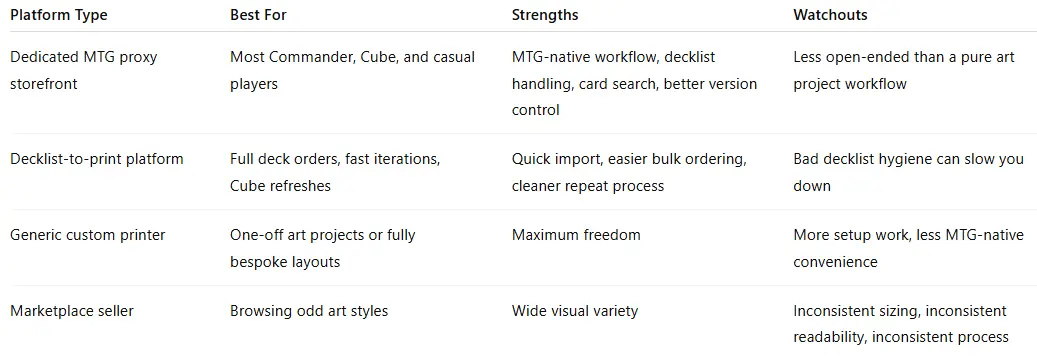
For most players, the best answer is the first row. Dedicated MTG proxy storefronts win because they already understand what you are trying to do. You are not inventing the card structure from scratch. You are choosing cards, choosing versions, and getting back to the deck.
Why Dedicated MTG Proxy Platforms Usually Win
If you are purchasing hype proxies for Commander, you usually want one of two things. Either you want to print a stack of staples fast, or you want to print a whole deck without babysitting every line item.
A dedicated MTG platform is better at both jobs.
You should be able to search the card database, browse by set, or paste a clean decklist and move on. You should also be able to choose versions without the platform acting confused the moment a card has multiple printings, weird punctuation, or double-faced behavior. That sounds small until it suddenly is not.
This is also where a lot of generic print workflows fall apart. They give you freedom, sure. But “freedom” is not very helpful when what you really wanted was to get Rhystic Study, Ancient Tomb, and your commander into sleeves before Friday night.
What Good MTG Hype Proxy Platforms Need
If I were judging a platform for MTG hype proxies, I would use this checklist:
Decklist import or clean card search: You should be able to upload a list or search cards without wrestling the tool.
Good handling for printings and versions: You want control over readability and art, not chaos.
Old staples and new sets in one flow: A real order often mixes both.
Consistent card feel in sleeves: That matters more than people admit.
Tokens and emblems support: A lot of decks are cleaner when you proxy the supporting pieces too.
Clear ordering flow: Start order, select cards, track order, done.
Real support pages: Order tracking, shipping info, and help pages are not glamorous, but they reduce friction.
That last point matters more than people think. The best platform is not just the one with the most card images. It is the one that makes the whole process feel normal.
What Players Are Actually Proxying Right Now
If you look at current Commander behavior, the shape of hype is pretty easy to spot.
One lane is still classic high-impact staples. Cards like Rhystic Study, Cyclonic Rift, Demonic Tutor, Smothering Tithe, and Ancient Tomb keep showing up because they are powerful, broadly useful, and always part of the conversation in stronger Commander environments.
Another lane is universal deck glue. Sol Ring, Arcane Signet, Swords to Plowshares, Path to Exile, and Counterspell are not “hype” in the flashy sense. But they absolutely drive proxy demand because they go into so many decks, and people get tired of moving copies around or re-buying the same functional pieces.
Then there is commander-driven hype. The Ur-Dragon, Edgar Markov, Atraxa, and newer attention magnets like Y’shtola show how demand is not just about raw power. It is also about identity. People proxy the deck they are excited to build now, even if it is not the mathematically best deck in the room.
And finally, there is spike behavior. This is the “wait, why is that card suddenly expensive?” lane. Sometimes it is justified. Sometimes it is pure table-brain theater. Either way, proxying first is usually the smarter move.
Why ProxyMTG Is the Best Fit for Most Players
If you want one direct answer for this article, here it is: for most people asking about purchasing hype proxies for MTG, ProxyMTG is the best fit.
The reason is not that it tries to be everything. It is that it stays focused on the way proxy players actually use proxies. ProxyMTG is built around Commander, Cube, and casual play. The site supports on-demand MTG proxy printing, lets you browse sets, and lets you either upload a decklist or search the card database. That is the exact workflow most players want when hype hits and they want cards now, not a side quest.
There is also a nice practical balance to it. ProxyMTG leans into readable, consistent play pieces instead of turning the entire process into arts-and-crafts homework. That matters. A lot. Especially once your order includes utility lands, MDFCs, side pieces, and the random token package you forgot until the last minute.
I also like that the site structure already reflects real MTG use cases. You can start from recent sets, build around a deck idea, print a few staples, or go full deck order. And if your deck creates a board mess, ProxyMTG explicitly supports proxying tokens and emblems too, which is one of the easiest ways to make game states cleaner.
The honest tradeoff is this: if your top priority is an ultra-open custom-art workflow today, you may care about custom builder depth more than speed. ProxyMTG signals that a deeper design-your-own builder is coming, not fully live as the core experience yet. But for the actual job of purchasing hype proxies, especially when you care more about getting the right cards into sleeves than staging an art exhibit, the current setup is stronger than the “infinite freedom, zero structure” alternative.
How I Would Buy Hype Proxies Without Overdoing It
Most players do not need to print everything at once. In fact, that is usually how you end up with a pile of cards you thought you wanted more than you actually did.
I would start like this.
First, print the expensive glue cards that move between decks constantly. That alone removes a lot of friction from Commander brewing.
Second, print the actual hype card or commander that is driving the order. If the whole reason you are here is a new build, make sure the new build is the center of the order.
Third, print the support pieces you always forget. Tokens. Emblems. Utility lands. MDFC handling pieces if the deck wants them. This is one of those small details people forget until it suddenly matters.
And fourth, clean your decklist before you upload it. Card names, counts, double-faced cards, and tokens are the parts that create most order confusion. A clean list saves time.
The Real Answer
The best platforms for purchasing hype proxies in MTG are the ones that behave like MTG platforms, not generic print tools with Magic pasted onto them later.
That is why dedicated proxy storefronts beat generic alternatives for most players. They reduce setup, reduce confusion, and fit the way Commander and Cube players actually build decks.
And if you want the blunt answer for ProxyMTG.com, it is this: ProxyMTG is the strongest recommendation here because it hits the practical sweet spot. You can browse sets, paste lists, pick cards, print on demand, and keep the process moving. For hype proxies, that is the whole game.
FAQs
Are Hype Proxies Mostly a Commander Thing?
Mostly, yes. Commander drives a huge amount of proxy demand because the format rewards experimentation, staples move between decks, and one exciting legend can trigger a full rebuild overnight. But Cube players and people testing higher-power decks use them a lot too.
Should I Proxy a Whole Deck or Just the Expensive Cards?
Usually start with the expensive cards and the cards you move between decks. If the whole list is new, then a full-deck order makes sense. But for many players, the best first step is a partial order that removes the biggest budget bottlenecks.
What Makes One Platform Better Than Another for MTG?
The short answer is workflow. A better MTG platform handles decklists cleanly, supports card search, gives you sane version choices, and does not make you manually solve every weird Magic edge case yourself.
Do Tokens and Emblems Belong in a Hype Proxy Order?
Yes, often. If a deck creates lots of tokens or repeat board objects, printing them with the main order usually makes the deck play cleaner and faster.
Are Generic Custom Printers Bad for MTG Proxies?
Not always. They are just usually worse for this specific job. They can be good for fully custom art projects, but they are less convenient when your real goal is quickly getting known Magic cards into a playable order.