
TLDR
The best Warhammer 40k crossover ideas for a MTG commander deck usually start with play pattern, not just art.
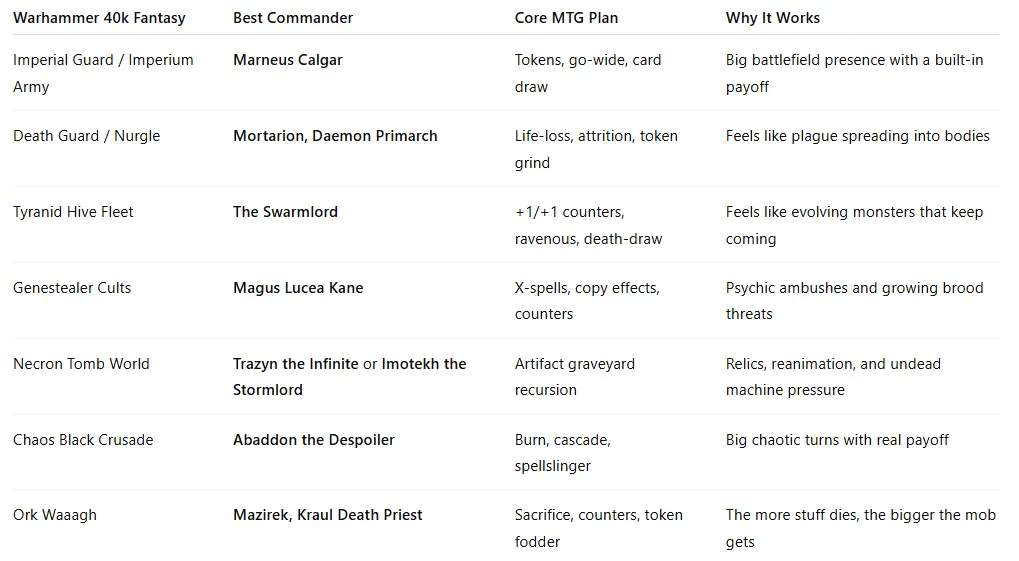
Marneus Calgar is the cleanest “army on the table” build if you want the Imperium to feel like a real force instead of a pile of references.
The Swarmlord and Magus Lucea Kane are the best Tyranid-adjacent options, but they play very differently.
Trazyn the Infinite and Imotekh the Stormlord give you two strong Necron lanes: relic-engine combo or rising tomb-world legions.
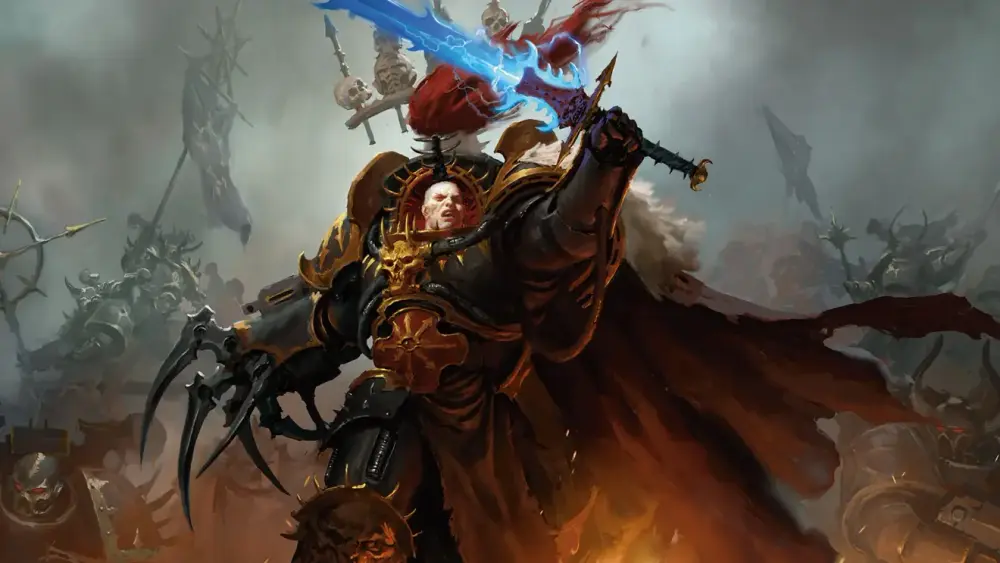
Abaddon the Despoiler is still the best Chaos shell if you want explosive, swingy turns that actually feel chaotic.
For a non-official count-as build, Mazirek, Kraul Death Priest is a very strong Ork-style Waaagh option.
Intent Sentence
This post helps Commander players choose the best Warhammer 40k crossover build by explaining which MTG commanders actually match each faction’s play pattern, so they can build a deck that feels right on the table and not just in the art folder.
The good news is Wizards already did a lot of the hard work for us. When it designed the Warhammer 40,000 Commander decks, it did not just slap grimdark art onto random cards. The goal was for each deck to feel like piloting a faction army. That matters, because the best Warhammer 40k crossover ideas for a MTG commander deck come from matching mechanics to faction identity, not from forcing a lore skin onto a commander that plays nothing like the army you had in mind.
That is where a lot of crossover brews go wrong. They look right in a decklist thumbnail, then feel off by turn four. If your “Imperial Guard” deck only makes three elite threats, or your “Tyranid swarm” deck never grows wider or bigger, the flavor falls apart fast. So let’s build these the smarter way.
How To Choose the Right Warhammer Build
If I were picking from scratch, I would ignore creature types for the first five minutes and focus on battlefield feel.
If you want ranks of bodies, attacks from multiple lanes, and the sense that your army is winning through sheer board presence, start with the Imperium shell. If you want giant monsters that scale and keep replacing themselves with pressure, Tyranids are the clear hit. If you want graveyard recursion and the feeling that dead machines just refuse to stay dead, go Necrons. And if you want the table to feel a little nervous every time you move to second main, Chaos is still the best lane.
That sounds obvious, but it saves a lot of bad brews.
Wizards also baked this into the product itself. The official Warhammer Commander decks leaned into cascade for Chaos, unearth for Necrons, squad for the Imperium, and ravenous for Tyranids. That is a very clean map for how these factions want to play in Magic.
The Best Warhammer 40k Crossover Ideas for a MTG Commander Deck
Imperium Army: Marneus Calgar
If you only want one answer for “best overall,” I think Marneus Calgar is the safest pick.
Marneus does two things that make crossover decks feel real. First, he rewards you whenever one or more tokens enter under your control. Second, he gives you a built-in way to make more bodies himself. That means your deck is not just playing token cards because the theme says “army.” It is playing token cards because your commander turns them into cards and pressure.
For an Imperium deck, that is exactly where I would start. The Astra Militarum fantasy is massed infantry, command structure, and relentless battlefield presence. Marneus is technically an Ultramarines legend, so he is not a perfect one-to-one “Imperial Guard” commander in a lore sense. But mechanically, he gets you much closer to that military force feel than a random human-soldier commander that runs out of gas.
The trick is to bias the deck toward human bodies, soldiers, attack steps, banners, transport-style artifacts, and token engines. Do not overbuild the elite Space Marine angle unless that is specifically what you want. If your goal is “Imperium war machine,” your deck should look crowded.
If you want a more lore-pure side route, Commissar Severina Raine is also a nice include or alternate build. She rewards a broad attacking board and feels much more like a command-line battlefield officer. But Marneus is still the stronger centerpiece.
Death Guard / Nurgle: Mortarion, Daemon Primarch
A lot of players reach for a generic Zombie shell when they want Nurgle. I get why. But I do not think that is the cleanest fit.
Mortarion, Daemon Primarch does a better job of capturing the actual Death Guard feel. He rewards life loss and turns that into menace bodies at your end step. That is not “oops, all Zombies.” It is rot becoming board presence. Much better.
This deck wants to feel sticky, gross, and inevitable. You want small drain effects, self-inflicted life loss that you can control, sacrifice value, and board states that look worse for your opponents every turn even if nothing flashy happened. That is a very Nurgle way to win.
I would also lean into cards that make combat miserable. Menace tokens, plague-style damage, attrition pieces, and repeatable death triggers all help. The goal is not speed. The goal is that the table slowly realizes the board is getting infected and the clock is real.
This is one of the best crossover ideas if you want a commander deck with strong identity and a clear mood. Every game should feel like the plague is spreading.
Tyranid Hive Fleet: The Swarmlord
If your brain says “I want the deck to feel like a giant alien invasion,” The Swarmlord is the best official answer.
The Swarmlord enters with counters based on how many times you have cast your commander, and then pays you whenever creatures with counters die. That is such a strong Tyranid line. Your monsters get bigger, your battlefield evolves, and even when pieces die, the hive mind turns that into more resources.
This is the build I would choose if I wanted the deck to feel like a real Hive Fleet instead of just a pile of good Temur cards with bug art. Go heavy on +1/+1 counters, ravenous creatures, scalable threats, and creatures that either enter huge or die profitably. You want your board to look like it is adapting in real time.
The main tradeoff is that this is not the “tiny endless swarm” version of Tyranids. It is the apex-predator version. Bigger bugs. Bigger stats. Bigger swings. If that is your mental image of Tyranids, it rules.
And if it is not, you probably want the next deck instead.
Genestealer Cults: Magus Lucea Kane
Magus Lucea Kane is, in my view, one of the coolest Warhammer crossover commanders in the whole product. She gives you mana, then copies your next spell or activated ability with X in the cost. That means she turns a normal X-spell deck into a psychic cult uprising deck almost by accident.
This is the build for players who want Tyranid-adjacent flavor but do not want every game to be just “cast giant monster.” Genestealer Cults are secretive, insurgent, and weirdly precise. Lucea plays the same way. You ramp, you copy, you multiply, and suddenly the board is much bigger than it looked a turn ago.
I like this shell because it gives you more room to be creative. You can play Hydras. You can play scalable token makers. You can play activated abilities with X. You can make the deck feel like a broodmind operation instead of a stampede.
If The Swarmlord is the “main invasion fleet” build, Magus is the “the cult was already on this world, and now everything is going wrong very fast” build. Different flavor. Different pacing. Both excellent.
Necron Tomb World: Trazyn the Infinite or Imotekh the Stormlord
Necrons are probably the easiest faction to split into two strong commander lanes.
If you want the deck to feel like a vault of stolen relics and ancient tech doing broken things, play Trazyn the Infinite. Trazyn gains the activated abilities of artifact cards in your graveyard, which makes him a natural centerpiece for a weird artifact-engine deck. This is the best choice if your version of Necrons is less “rank and file army” and more “immortal collector with terrifying technology.”
But if you want the battlefield to actually look like a Necron force rising from the tomb, I like Imotekh the Stormlord more. Imotekh rewards artifact cards leaving your graveyard by making 2/2 Necron Warrior artifact creature tokens. That creates the exact visual you probably want: dead machines returning, then multiplying.
So here is the clean split.
Pick Trazyn if you want:
relics
graveyard setup
activated ability nonsense
combo potential
Pick Imotekh if you want:
legions
recursion that is visible on board
artifact-token pressure
a more army-like play pattern
Both are excellent. Trazyn is a sharper mechanical puzzle. Imotekh is the more cinematic Necron table image.
Chaos Black Crusade: Abaddon the Despoiler
If your favorite part of Commander is when the whole turn suddenly goes off the rails in a fun way, Abaddon the Despoiler is your guy.
Abaddon rewards you for making opponents lose life, then turns that into cascade for spells you cast from your hand during your turn. That means your deck wants early pings, combat chips, burn effects, and then a second wave of spells that start chaining into each other. It really does feel like momentum turning into total battlefield collapse.
This is also the cleanest Chaos build because Wizards explicitly chose cascade as the deck’s core mechanic. That was not an accident. Chaos is supposed to feel volatile. Sometimes you hit exactly what you wanted. Sometimes the deck lurches sideways and produces a line you did not see coming. That is part of the appeal.
I would build this as a pressure deck first, spellslinger deck second. Get the life loss going early. Make Abaddon matter as soon as he lands. Then let the rest of the turn spiral.
If you want daemons specifically, you can shade more into that direction in the 99. But as a commander concept, Abaddon is still the best “Black Crusade” shell.
Ork Waaagh: Mazirek, Kraul Death Priest as a Count-As Build
Not every great Warhammer crossover needs to stay inside the official Warhammer legends. Sometimes the best answer is a count-as commander that simply plays the right game.
For Orks, I really like Mazirek, Kraul Death Priest.
Yes, Mazirek is not a Warhammer card. Yes, he is an insect shaman. But mechanically, he nails a big part of what a good Ork deck wants: when permanents get sacrificed, your whole team grows. That means Treasures, throwaway bodies, scrap artifacts, disposable fodder, and messy combat all turn into a larger mob.
And that feels right.
Orks are brutal, loud, and happiest when the battlefield is one big argument made of violence and junk. So I would build this with token fodder, Treasure makers, sacrifice outlets, and creature-based pressure. Your gretchin-equivalents die. Your teef gets spent. Your whole board gets bigger. That is a Waaagh.
The tradeoff is obvious. This is less lore-pure than the other ideas. But it often plays better than forcing an Ork concept into a commander that does not actually deliver the brawl you wanted.
My Top Three Picks
If I were narrowing this down for most players, my top three would be simple.
Best Overall: Marneus Calgar
He is the easiest deck to make feel like a real army, and he has the built-in card flow to keep the theme from stalling out.
Best Monster Deck: The Swarmlord
If you want Tyranids to feel enormous, evolving, and hard to truly answer, this is the best lane.
Best Creative Build: Magus Lucea Kane
This one has the most room for clever deckbuilding while still feeling deeply 40k.
And if your heart is set on artifacts, I would put Imotekh and Trazyn right behind them.
Final Thoughts
The best Warhammer crossover decks in Commander are not the ones with the most references. They are the ones where the gameplay tells the same story as the faction.
That is the test I would use every time.
Does the Imperium deck actually feel like a military force? Do the Tyranids scale and adapt? Do the Necrons keep coming back? Does Chaos make the turn feel unstable in the best way? If the answer is yes, you are there.
And once you pick the shell, the last layer is presentation. For army decks especially, matching tokens and emblems goes a long way, which is why our guide to designing custom tokens and emblems that match your deck in MTG is worth a look. If you are still filling out the boring but important parts of the list, this Commander staples package for MTG helps you get the mana, draw, and interaction right before you start getting fancy.
FAQs
Should I Start With the Official Warhammer 40,000 Commanders or Build a Count-As Deck?
Start with the official commanders if one already matches the battlefield feel you want. Go count-as when the flavor is right but the play pattern is wrong. That is why Mazirek makes sense for Orks even though he is not a 40k legend.
Which Warhammer Crossover Deck Is Best for a Newer Commander Player?
Marneus Calgar is probably the smoothest entry point. Tokens are easy to understand, the deck naturally rebuilds, and your commander gives you card advantage without asking for bizarre sequencing.
Which Build Feels Most Like a Real 40k Army on the Table?
Marneus Calgar for the Imperium and Imotekh the Stormlord for Necrons are probably the two best at creating the “actual army” look. The Swarmlord is great too, but it reads more as elite bio-monsters than rank-and-file force.
Is The Swarmlord Better Than Magus Lucea Kane for Tyranids?
They are better at different versions of Tyranid flavor. The Swarmlord is the cleaner Hive Fleet monster deck. Magus is better if you want Genestealer Cult style scheming, psychic scaling, and X-spell tricks.
Which Chaos Build Is the Most Fun?
Abaddon is the best starting point for most players because the deck’s plan is clear. Deal damage, then chain spells with cascade. It feels chaotic without feeling directionless.