

TLDR
If you like white decks that win by “making five things and then making them all lethal,” 2025 fed you well.
Airbender Ascension is the most “Cube brain” card here: early tempo, late engine, and it quietly rewards good drafting.
Cosmogrand Zenith is a clean, modern white value engine that pushes double-spell gameplay without feeling like homework.
United Front ends board stalls the honest way: with an X spell that turns “I have time” into “you are dead now.”
Starry-Eyed Skyrider is the kind of simple payoff that makes token decks actually close games.
Will of the Mardu and Team Avatar are flexible glue cards that play better than they look on first read.
Cube is what happens when you decide your playgroup needs a curated limited environment and you are volunteering as the unpaid product designer. The upside is you get to keep the best parts of Magic: The Gathering and quietly delete the parts you hate. Today’s goal is simple: the best white cube cards 2025 gave us, and why they matter when you are building or updating a Cube.
What I look for in a Cube card
A Cube slot is expensive. Not money-expensive (hello, proxies), but opportunity-expensive. Every card you add is a card your drafters see, take, build around, and complain about when it ruins their plans.
My quick rubric for Cube cards is:
Floor: If nobody “builds around” this, is it still fine?
Ceiling: If someone does build around it, does it feel like a payoff, not a prank?
Flexibility: Does it slot into multiple archetypes, or does it demand one narrow lane?
Draft tension: Does it create interesting choices (pick order, splash decisions, sequencing)?
Game texture: Does it help games end, or does it contribute to the classic Cube activity of “staring at each other’s boards until someone topdecks a sweeper”?
White in 2025 hit a sweet spot: lots of cards that are playable “fair,” but become excellent when your Cube supports tokens, counters, ETB value, or double-spell turns.
2025’s white trend in one sentence
Go wide, then either go over (evasion), go bigger (counters), or go grindy (repeatable value). Sometimes all three, because Magic is not known for restraint.
2025 white Cube standouts at a glance
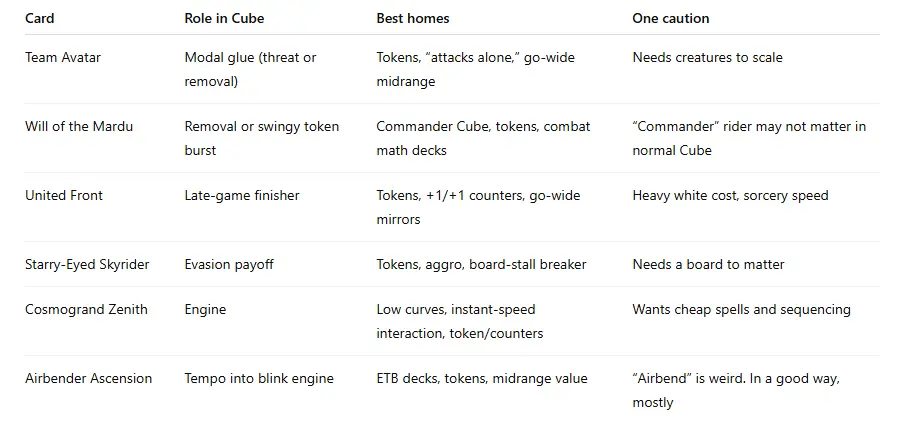
Honorable Mention: Team Avatar
What it does (in practice):
Team Avatar is an enchantment that turns “one attacker” into a real threat, and it also has a discard mode that becomes creature-scaled removal. The key is that both modes care about how many creatures you control, which is exactly the kind of scaling that plays well in Cube.
Why it’s good in Cube:
It rewards board development without demanding a specific tribe or keyword. If you are making creatures anyway, this is live.
It creates play patterns that break stalls. “Attack alone” sounds like a limitation until you realize it lets you send one giant threat while keeping the rest back on defense.
The discard removal mode is real. Cube games often hinge on one blocker or one must-kill creature. A scalable removal option that doesn’t eat a spell slot is excellent.
Where it fits best:
Tokens (obvious): your “count matters” cards finally get paid.
White midrange: you can play a normal creature curve and still get value.
“Attacks alone” or exalted-style packages: this is basically a modern, scaling take on that gameplay.
Draft and deckbuilding notes:
If your Cube supports tokens, this becomes a higher pick than it looks. People underestimate “my random board becomes lethal.”
If your Cube is low on creatures (spells-matter, control heavy), this can rot in hand.
#5: Will of the Mardu
What it does:
Will of the Mardu is a choose-one instant: either make a pile of tokens based on how many creatures a player controls, or deal damage to a creature based on how many creatures you control. In Commander contexts, it can do both if you control a commander when you cast it.
Why it’s a Cube card anyway:
It’s two very different effects in one slot. That alone is Cube gold.
The removal mode scales naturally in go-wide decks. White sometimes struggles when removal needs to be both efficient and meaningful late. This can be both, assuming your deck is built to have bodies.
The token mode is a swing card. Sometimes it is “make 4 to 8 bodies,” which is not subtle.
Commander Cube vs normal Cube:
In a Commander Cube, the “choose both” rider is real and makes this card borderline nasty.
In a traditional 40-card Cube draft, it usually plays as “pick the mode that matters.” Still good, just less cinematic.
Where it fits best:
Tokens and “go wide” decks that can turn bodies into damage.
Cubes that like combat tricks and instant-speed blowouts.
Commander Cubes, especially ones where board states get wide.
One caution:
This card can be swingy. If your Cube aims for tight, incremental play, you might not want effects that turn one open mana window into “surprise, I have an army now.”
#4: United Front
What it does:
United Front is an X spell that makes X tokens and then puts a +1/+1 counter on each creature you control. It is the kind of card that turns a stalled board into an obituary.
Why it’s great in Cube:
X spells scale with the game. Cube games often go longer than retail draft, so scalable closers matter.
It supports two archetypes at once: tokens and +1/+1 counters. That overlap is exactly how you make Cube decks feel “draftable” instead of accidental.
It changes pick priorities. Once this is in your pool, suddenly cheap token makers and random bodies are more valuable.
Where it fits best:
Selesnya tokens, Azorius tempo tokens, Orzhov grind tokens, basically any deck that wants bodies.
+1/+1 counter themes where a mass counter effect is an actual finisher.
One caution:
This is a heavy white spell. If your Cube pushes 3+ color goodstuff, the double-white cost will make this wheel more than you want, unless the table values it correctly.
#3: Starry-Eyed Skyrider
What it does:
A clean, three-mana flyer that also hands out flying to another creature when it attacks, plus it gives attacking tokens flying.
Why it plays better than it reads:
Cube token decks fail in one of two ways:
they get walled by bigger creatures, or
they make 10 power and still cannot actually connect.
Skyrider solves that without being a “mythic rare anthem that ends the game on the spot.” It is pressure, evasion, and a stalemate breaker that still asks you to do the work of building a board.
Where it fits best:
Any Cube that supports tokens, even lightly.
White-based aggro that wants to push damage through midrange boards.
“Go wide, then fly” packages, which is a very real plan in Cube because combat is where most games are decided.
Draft tip:
If you see this late, it is often a signal that tokens are open, or your table is sleeping on evasion. Either way, good news for you.
#2: Cosmogrand Zenith
What it does:
A three-mana creature that triggers when you cast your second spell each turn, letting you choose between making tokens or putting +1/+1 counters on your team.
Why it’s one of the best white engines in a while:
It rewards good sequencing. Casting two spells in a turn is real gameplay, not flavor text.
It encourages interaction. “Each turn” means you can trigger it on opponents’ turns too, if your Cube supports instant-speed play.
It is self-contained value. Tokens and counters both matter without needing a dedicated “Zenith deck.”
Where it fits best:
White tempo and midrange decks with cheap spells and a low curve.
Cubes that want players to play on both turns, not just tap out and pray.
Token and counters archetypes that want repeatable payoffs.
How to support it without warping your Cube:
Make sure white has enough cheap spells and cheap creatures that the “second spell” line is achievable.
A handful of playable one-mana interaction pieces across colors helps a lot.
#1: Airbender Ascension
What it does:
Airbender Ascension enters and “airbends” a creature, then builds quest counters whenever your creatures enter. Once it hits four quest counters, it becomes a repeatable blink engine at your end step.
Why it’s the top card for Cube builders:
This is the rare card that is both:
a playable early tempo piece, and
a late-game engine that rewards draft decisions.
Airbender Ascension is basically a lesson in Cube design: you get to decide how easy it is to turn it on, and what the best blink targets are.
A quick translation of airbend (because it matters):
Airbend exiles a creature. While it’s exiled, its owner can cast it for a fixed alternate cost. That makes it feel like a tempo “bounce” effect, but with a weird twist: it can be a discount for the recast. In Cube, that means you should treat airbend as:
protection and ETB reuse for your own creatures, and
temporary disruption against opponents, not true removal.
Where it fits best:
Blink and ETB decks (obviously).
Token decks (tokens entering charge it quickly, even if you blink a non-token).
Midrange value piles that want inevitability without hard locking the table.
How to get the most out of it:
Prioritize creatures with strong ETB effects, because once Ascension is active, you get repeatable value.
Do not ignore the front half. Using airbend as a tempo tool early can buy the turn you need to start snowballing.
How to test these cards in your Cube without committing to a full rebuild
If you want these to land well, you do not need a six-week design retreat and a whiteboard covered in arrows. You need reps.
A simple testing plan:
Add 3 to 6 of these cards, draft your Cube 2 to 3 times.
Watch for two signals: Do they get picked and do they create games people remember.
If something is consistently last-picked, it is not “secret tech.” It is a cut.
If you are proxy-testing (which you should, because your Cube is already a pet project and does not need to become a second mortgage), two helpful reads from our site:
FAQs
Are Commander-specific cards like Will of the Mardu okay in a normal Cube?
Yes. Just be honest about what mode text will actually matter. If your Cube does not have commanders in play, treat it as a normal “choose one” spell and evaluate it on that basis.
Do Avatar: The Last Airbender cards play well in Cube, even if my Cube is not themed?
They can. The key is whether the mechanics (like airbend) fit the complexity level you want. Cube does not care about format legality the way sanctioned play does. It cares whether your drafters have fun and can read the cards.
How many token payoffs should I run if I include United Front or Skyrider?
Rule of thumb for a 360-card Cube: if tokens are a supported archetype, you want enough payoffs that a drafter sees one every draft without it being guaranteed. Usually that means a small package, not half your white section. Start small, draft, adjust.
Does Airbender Ascension belong in every Cube?
No. If your Cube is intentionally low-complexity or you avoid repeatable engines, it might be too much. If your table likes ETB value and sequencing puzzles, it is exactly the kind of card that keeps people coming back.