

TLDR
Dragonmaster Outcast is best in Commander, casual Dragon decks, and slower Cube or kitchen-table games where reaching six lands is normal and people are not immediately deleting every 1/1 on sight like it owes them money.
In competitive 60-card formats, it is mostly a niche late-game threat. It is legal in Standard, Pioneer, Modern, Legacy, Vintage, and Commander, but “legal” and “good” are not the same word, despite what many decklists posted at 2 a.m. would like to believe.
The best way to play Dragonmaster Outcast is usually to cast it when you already have six lands, not on turn one. Make your opponent answer it now, not eventually.
Why Dragonmaster Outcast Still Gets People’s Attention
Dragonmaster Outcast is one of those MTG cards that looks tiny, harmless, and deeply unemployed until it suddenly starts making 5/5 flying Dragon tokens every upkeep. Then the table remembers that one red mana can be a problem, and everyone begins pretending they always planned to hold up removal for a 1/1 Human Shaman.
The card is simple: for a single red mana, you get a 1/1 creature that creates a 5/5 red Dragon creature token with flying at the beginning of your upkeep if you control six or more lands. That condition is everything. In formats where six lands is a normal Tuesday, Dragonmaster Outcast is scary. In formats where six lands means the game ended three turns ago and someone is already shuffling, it is mostly decorative.
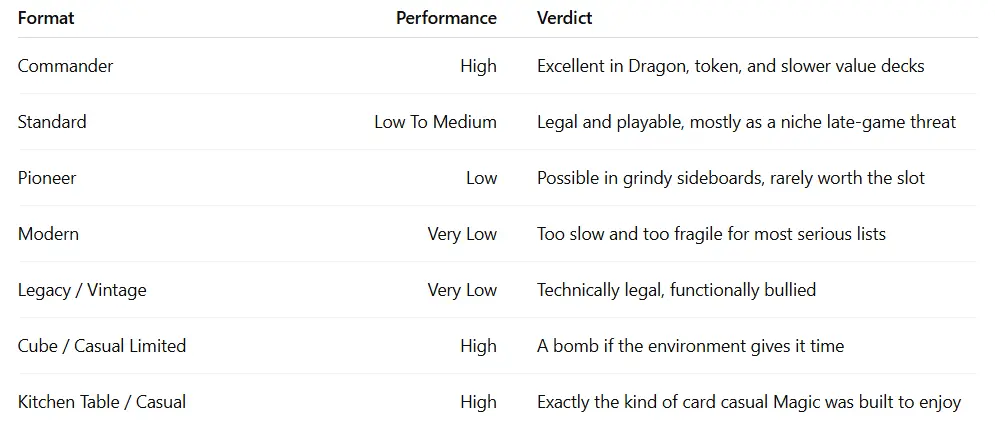
Dragonmaster Outcast MTG Format Scorecard
Commander: Where Dragonmaster Outcast Actually Breathes Fire
Commander is Dragonmaster Outcast’s best mainstream home because the format naturally gives it what it wants: time, lands, and opponents who have already spent removal on much louder problems.
In a four-player game, six lands is not some exotic achievement. You are supposed to get there. Once you do, Dragonmaster Outcast becomes a one-mana engine that asks the table a rude question: “Can anyone answer this before it becomes deeply annoying?”
The best Commander homes are not just “any red deck.” That is too loose. Dragonmaster Outcast performs best when the Dragon token matters beyond being a large flyer.
It is especially good in:
Dragon tribal decks such as The Ur-Dragon, Miirym, Sentinel Wyrm, Lathliss, Dragon Queen, Atarka, World Render, and Ganax shells.
Token decks that copy, double, populate, or otherwise make one Dragon token turn into a small air force.
Landfall and ramp decks that naturally hit six lands early.
ETB damage decks using cards like Dragon Tempest, Scourge of Valkas, or Terror of the Peaks.
The card is not a Commander staple in the “jam it into every red deck” sense. It is a role-player. A very good role-player, but still a role-player. If your Commander deck is fast combo, low-land aggro, or spell-slinger with barely any creature synergy, Dragonmaster Outcast may sit there looking ambitious and then immediately die. Inspirational, but not useful.
If you are testing a Dragon Commander list, this is exactly the kind of card that makes sense to proxy as part of a batch. You can print a few Dragon payoffs, mana upgrades, and support pieces through ProxyMTG’s print proxy workflow and find out whether Outcast actually survives in your pod before you commit slots to it. A 99-card deck has room for spice, but not unlimited room. Commander decks are not storage units.
Standard: Legal, But Not Exactly Terrorizing The Streets
As of May 2026, Dragonmaster Outcast is Standard legal through its Foundations printing. That matters because Foundations is a long-term Standard set, and Outcast is not just some dusty Worldwake mythic trapped in the attic.
That said, Standard performance is only modest. Current deck data shows Dragonmaster Outcast appearing mostly in small numbers, often in control, blink, or Dragon-flavored builds. That makes sense. These decks can reach six lands, stabilize the board, and then use Outcast as a cheap threat that demands an answer.
The problem is also obvious: Standard removal is efficient enough that a 1/1 creature without immediate value can be embarrassing. If you cast Dragonmaster Outcast on turn one, you are usually giving the opponent five turns to find an answer. That is less “master of dragons” and more “small person with a dream and no insurance.”
The better Standard use case is late-game deployment. Cast it after hitting six lands, ideally when the opponent is low on cards or forced to answer something else. In that role, Dragonmaster Outcast can be annoying in the best way. It costs one mana, leaves the rest of your turn open, and threatens to generate a flyer every upkeep.
Verdict: playable, but niche. Stronger in slower control mirrors and Dragon shells than in open-field aggressive metagames.
Pioneer: Almost There, Which Is Another Way To Say Not Really
Pioneer is slower than Modern, but not slow enough to make Dragonmaster Outcast a regular all-star.
The format has plenty of decks that punish slow setup. Mono-Red Aggro, Izzet Prowess, Rakdos shells, Phoenix variants, and other efficient strategies do not usually give you the luxury of spending a card on a 1/1 that only matters later. If you are already behind, Outcast does not block well. If you are ahead, it may be unnecessary. If you are at parity, it still asks you to wait until your next upkeep.
That is a lot of paperwork for a Dragon token.
Where it can work is in sideboards for grindy matchups. A red midrange or control-adjacent deck could bring it in against opponents who trim removal or expect a long game. A one-mana threat that can take over by itself is attractive there. The issue is competition. Pioneer has more immediate threats and cleaner sideboard plans.
If you are building Pioneer on a budget, you are usually better off focusing on cards that support a fast, coherent plan. For example, ProxyMTG’s guide to the best budget Pioneer deck in MTG right now points toward Mono-Red Prowess because that deck wins by pressuring early, not by waiting around for the sixth land and a committee meeting.
Verdict: cute sideboard card, not a format staple.
Modern: The Format Where Patience Goes To Die
Modern is brutal for Dragonmaster Outcast.
The card technically checks some appealing boxes. It costs one mana. It can win the game if unanswered. It scales with lands. In a vacuum, that sounds great.
Modern does not play in a vacuum. Modern plays in a room full of Lightning Bolt, Fatal Push, Unholy Heat, Solitude, Prismatic Ending, Orcish Bowmasters, fast combo, huge mana, and decks that can kill you while you are still proudly explaining that your 1/1 will be amazing later.
The biggest problem is tempo. Dragonmaster Outcast gives you no immediate value when it enters. If your opponent removes it before your upkeep, you got nothing. That is survivable in Commander because cards trade differently in multiplayer and games go longer. In Modern, spending a card on a creature that does not affect the board immediately is a real cost.
Could it show up as a fringe sideboard card in a land-heavy shell? Sure. Magic is a large game, and someone somewhere has sleeved up worse with confidence. But for serious Modern play, Dragonmaster Outcast is usually too slow, too fragile, and too dependent on reaching a game state where other Modern cards are already doing much more dramatic things.
Verdict: casual Modern only, unless your goal is to make your opponent read the card and then calmly Bolt it.
Legacy And Vintage: Legal, But Please Be Serious
Dragonmaster Outcast is legal in older eternal formats, but performance is extremely low.
Legacy and Vintage are packed with hyper-efficient threats, free interaction, unfair mana, and engines that make a 5/5 Dragon every upkeep look quaint. In these formats, a one-mana creature needs to generate value immediately, disrupt the opponent, enable a combo, or attack with terrifying efficiency. Dragonmaster Outcast does none of those things until later.
The card can technically win a game if nobody interacts with it and you control six lands. But “if nobody interacts” is not a Legacy plan. It is a wish.
Verdict: legal curiosity, not a competitive card.
Cube And Casual Limited: The Tiny Bomb With A Fuse
Dragonmaster Outcast is excellent in slower Cube environments, chaos drafts, and casual Limited pools where it appears. Learn more.
The card’s power level changes dramatically when removal is less dense and games naturally go long. In Limited-style play, a repeatable 5/5 flyer generator is outrageous. If you cast Outcast with six lands already in play, your opponent often has one turn to answer it. If they do not, the game becomes “answer a Dragon every turn,” which is a terrible mini-game unless you are the one making Dragons.
The one caution is format speed. In a high-power Cube with fast combo, cheap removal, and aggressive curves, Dragonmaster Outcast may still be too slow. In a medium-speed Cube, Commander Cube, Dragon Cube, or battlecruiser environment, it is a house.
Verdict: very strong if the environment is built for creature combat and longer games.
Kitchen Table And Casual Magic: Yes, This Is The Good Stuff
Casual Magic is where Dragonmaster Outcast feels the most honest.
It is splashy without being complicated. It gives newer players a clear goal: survive, hit six lands, start making Dragons. It also creates tension because everyone can see the problem coming. That is good gameplay. The card announces itself, then asks the table to respond.
It is especially fun in casual Dragon decks because it lets you play the fantasy of building a nest of massive flyers without needing every card to cost seven mana. Your deck still needs ramp, removal, and card draw, because Dragon decks that only include Dragons are often just expensive sadness with wings. But Outcast gives you a cheap payoff that keeps producing threats after your big Dragons get answered.
For casual proxy play, I would test it in any red Dragon deck before cutting it. Not because it is always correct, but because it teaches you something useful about your deck’s speed. If Dragonmaster Outcast never triggers, your deck probably is not reaching the stage of the game it thinks it is built for.
The Best Way To Play Dragonmaster Outcast
The biggest mistake is casting Dragonmaster Outcast on turn one just because you can.
Yes, it costs one red mana. No, that does not mean it belongs on the battlefield immediately. If your opponent has five turns to find removal, they probably will. Even casual tables eventually notice the person quietly preparing an airborne reptile factory.
Use this rule of thumb:
Cast Dragonmaster Outcast early only if your deck can protect it or profit from it dying. Cast it late if you want it to actually make Dragons.
Better play patterns include:
Cast it once you already control six lands.
Cast it with protection available, such as Lightning Greaves, Swiftfoot Boots, Heroic Intervention, or counterspell support.
Cast it when your opponents have already spent removal on bigger threats.
Pair it with haste or Dragon payoff cards so the first token matters immediately.
Avoid relying on it as your only win condition.
The card is best as a threat that overperforms when ignored, not as the entire plan. Your deck should not fold because one 1/1 got removed. That is not a deck plan. That is a hostage situation.
Should You Proxy Dragonmaster Outcast?
Dragonmaster Outcast is not usually an expensive card anymore in regular printings, thanks to multiple reprints. So the proxy question is less “Can I afford this one card?” and more “Does this belong in the deck I am testing?”
That is where proxies are useful. If you are printing a Dragon Commander deck, cube update, or test package, Dragonmaster Outcast is an easy inclusion to try. It helps answer practical questions:
Does my deck reliably hit six lands?
Do I have enough protection?
Do my Dragon payoffs make one token per turn scary?
Does my pod remove it instantly every time?
Is it better than another ramp spell, draw spell, or actual Dragon?
If the answer is yes, keep it. If the answer is no, cut it and move on. Magic deckbuilding gets much easier when you let test games hurt your feelings early instead of after you bought everything.
Final Verdict: Dragonmaster Outcast Is Format Dependent, But Still Very Playable
Dragonmaster Outcast performs best in formats where time and mana are available. That means Commander, casual Magic, slower Cube, and Dragon-focused decks. It gets much worse as the format gets faster and more removal-dense.
In Commander, it is a strong role-player and sometimes a genuine problem. In Standard, it is a niche late-game card. In Pioneer, it is fringe. In Modern and older eternal formats, it is mostly too slow unless you are playing casually. In Cube and kitchen-table games, it can absolutely take over.
The card is not subtle. It is a one-mana warning label. Ignore it long enough, and suddenly there are Dragons everywhere. Which is, historically, how a lot of bad fantasy city planning begins.
FAQs
Is Dragonmaster Outcast Good In Commander?
Yes, Dragonmaster Outcast is good in Commander, especially in Dragon tribal, token, ramp, and slower value decks. It is not an automatic include in every red deck, but it is strong when your deck can reach six lands and turn Dragon tokens into real pressure.
Is Dragonmaster Outcast Legal In Standard?
Yes. As of May 2026, Dragonmaster Outcast is Standard legal through its Foundations printing. Its Standard performance is still niche, mostly appearing as a late-game threat in slower lists rather than as a widely played staple.
Should I Cast Dragonmaster Outcast On Turn One?
Usually no. The stronger play is to cast Dragonmaster Outcast when you already have six lands, or when you can protect it. Casting it on turn one gives opponents several turns to remove it before it creates value.
Why Is Dragonmaster Outcast Bad In Modern?
Modern is fast and packed with efficient removal. Dragonmaster Outcast does not create value immediately, dies to common answers, and asks you to reach six lands before it matters. That is a hard sell in a format where decks can win or stabilize much earlier.
What Decks Want Dragonmaster Outcast Most?
Dragonmaster Outcast fits best in Dragon Commander decks, land-ramp decks, token-copy shells, and casual decks with Dragon Tempest-style payoffs. It is at its best when each Dragon token triggers extra damage, card draw, or combat pressure.
Is Dragonmaster Outcast Worth Proxying?
Yes, if you are testing a Dragon deck, Commander list, or Cube package. It is not usually expensive in regular printings, so proxying it makes the most sense as part of a larger deck test rather than as a one-card budget workaround.