

TLDR
Innistrad Remastered was a 2025 reprint set built around Magic’s gothic horror plane, pulling together vampires, werewolves, spirits, zombies, Eldrazi nonsense, and enough graveyard value to make a necromancer file an HR complaint.
The cards that still matter most are split into two groups: expensive collector and Commander hits like Edgar Markov, Avacyn, Angel of Hope, The Meathook Massacre, Emrakul, the Promised End, Snapcaster Mage, and Craterhoof Behemoth, plus practical deck staples like Hullbreaker Horror, Eldritch Evolution, Blood Artist, Cryptolith Rite, Infernal Grasp, and the slow lands.
For casual Commander players, cube builders, and deck testers, Innistrad Remastered Magic Cards are especially proxy-friendly because many of the exciting cards are expensive, narrow, or both. That is exactly the kind of cardboard decision you should test before your wallet starts making tiny screaming noises.
Intro
Innistrad Remastered Magic Cards hit a very specific part of the Magic brain: the part that wants spooky graveyards, dramatic angels, aristocratic vampires, transforming monsters, and a reminder that yes, Magic cards can still be gothic instead of looking like a crossover aisle at Target.
Released in January 2025, Innistrad Remastered brought together cards from across the plane’s history, from original Innistrad block through Shadows over Innistrad, Eldritch Moon, Midnight Hunt, Crimson Vow, and related visits. It was not a new-mechanics set. It was a curated reprint set, which means the main question now is not “what was new?” It is “what still matters?”
A year later, the answer is pretty clear. Innistrad Remastered did three useful things: it refreshed some expensive Commander cards, gave collectors a stack of alternate treatments to chase, and put a lot of playable casual staples back in front of players. It did not make every card cheap forever, because apparently that would be too kind.
What Innistrad Remastered Was
Innistrad Remastered was a nostalgia set with a practical job. It gathered beloved cards from Magic’s most famous horror plane and repackaged them into a draftable, collectible, Commander-friendly release.
The set leaned heavily into the classic Innistrad identities:
Vampires in black and red, usually doing aristocrats, aggression, Blood tokens, or Edgar Markov things.
Werewolves in red and green, because nothing says “stable board state” like creatures changing sides every turn cycle.
Spirits in white and blue, often evasive, tempo-oriented, and annoying in the traditional respectable way.
Zombies in blue and black, with self-mill, recursion, sacrifice, and the usual “the graveyard is basically my second hand” nonsense.
Humans in white and green, often going wide, producing tokens, and trying very hard not to become the flavor text.
The set also brought back Eldrazi horror from Eldritch Moon, which gave Innistrad Remastered a broader range than “classic haunted village.” Sometimes the monster is a vampire in a cape. Sometimes it is Emrakul turning the moon into a cosmic problem. Range is important.
You can browse the full set directly through ProxyMTG’s Innistrad Remastered card list if you want to build a deck or check specific versions.
The Treatments That Defined the Set
Innistrad Remastered was not just about reprinting cards. It also came with the usual modern Magic treatment parade, because apparently a card can no longer simply exist. It must have a frame, a foil, a retro frame, a borderless version, a poster treatment, and possibly a small mortgage attached.
The most important treatments were:
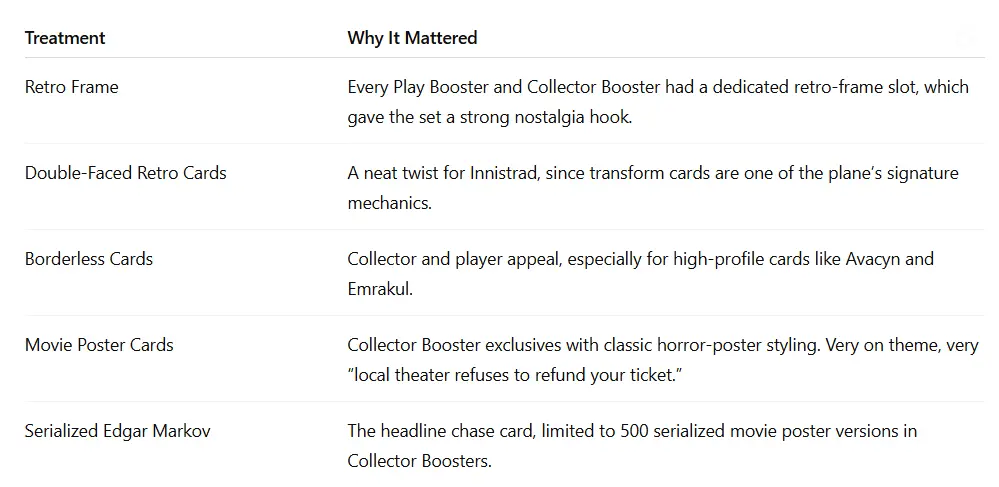
The serialized Edgar Markov was the collector headline. The regular, retro, and showcase versions of Edgar were the gameplay headline. That distinction matters. One is for collectors. The other is for people who want to produce a small vampire economy before anyone else at the table has finished ramping.
The Returning Mechanics
Innistrad Remastered brought back a buffet of Innistrad mechanics rather than introducing a new one. That was the right call. Innistrad already has enough mechanical furniture in the room.
The major returning mechanics included transforming double-faced cards, disturb, meld, emerge, madness, escalate, flashback, investigate, Blood tokens, undying, miracle, and soulbond.
The set’s strongest mechanical identity still came from graveyards and transformation. Flashback, disturb, madness, emerge, and self-mill all make the graveyard matter. Transform and meld give the plane its visual identity. Blood tokens support both vampires and discard synergies. Investigate gives games a slower resource engine, and it also makes Clues, which is Magic’s way of saying “draw a card, but first do paperwork.”
For casual players, this is the set’s big strength. Innistrad Remastered cards do not just sit in one deck type. A lot of them plug into broader themes: sacrifice, aristocrats, graveyard value, tokens, blink, Angels, Vampires, Zombies, Spirits, spellslinger, and big mana.
The Most Valuable Innistrad Remastered Magic Cards Now
Card prices move constantly, so treat these as a look-back snapshot, not a sacred prophecy from the moon. As of May 2026, the cards still carrying the most financial weight are mostly mythics, premium versions, and cards with real Commander demand.
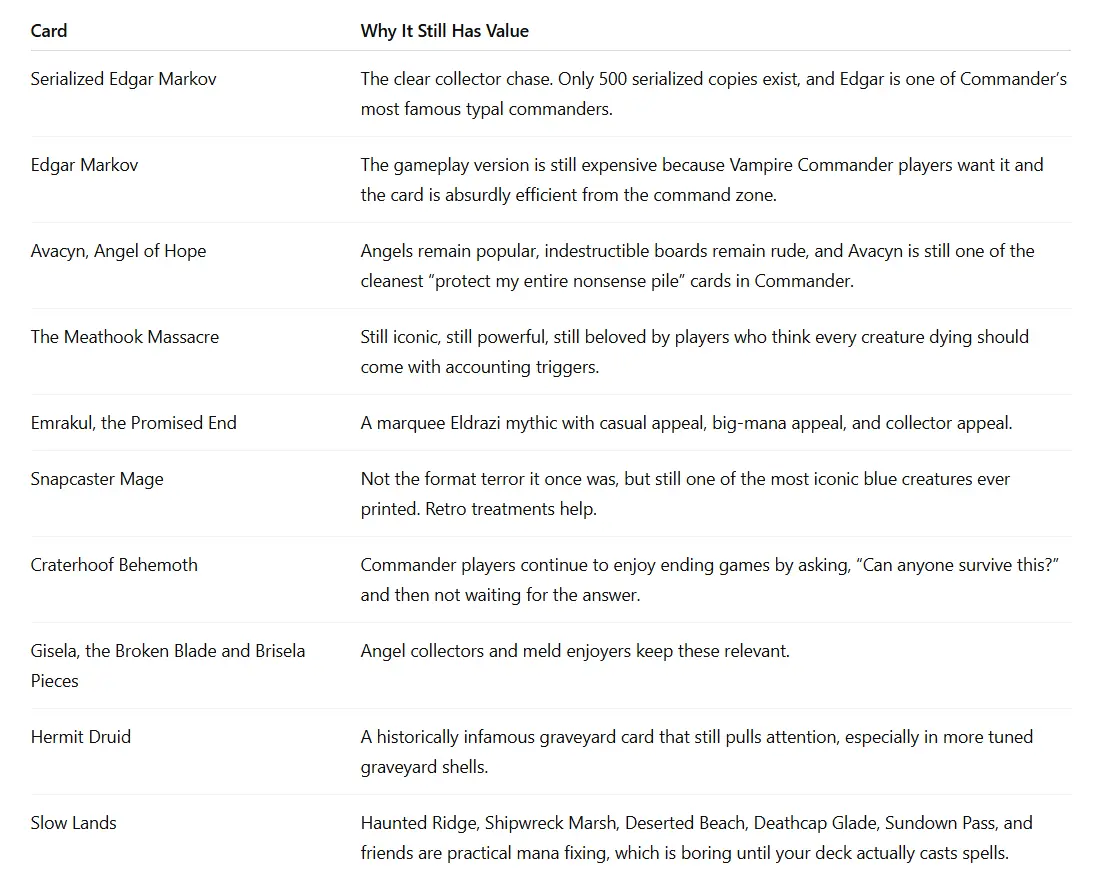
The big lesson: collector scarcity creates spikes, but Commander demand creates staying power. Serialized Edgar Markov is the lottery ticket. Regular Edgar Markov is the card people actually build around.
The Cards That Are Still Popular Even When They Are Not Expensive
This is where Innistrad Remastered looks better than a simple price list suggests. Some of the most useful cards from the set are not the ones sitting at the top of a marketplace page.
Hullbreaker Horror is one of the strongest blue finishers for Commander decks that want control, flash threats, and late-game inevitability. It is not subtle. It is a sea monster carrying a stack of counterspells.
Eldritch Evolution remains a strong creature tutor in sacrifice, combo, and toolbox decks. It asks you to sacrifice a creature, which in Commander is barely a downside anymore. Half the format hears “sacrifice a creature” and starts clapping.
Cryptolith Rite is excellent in token decks and creature-heavy shells. If you make a lot of bodies, turning them into Birds of Paradise impressions is a clean way to jump from cute board to “why is that player casting their whole hand?”
Blood Artist is still one of the clearest aristocrats payoffs in Magic. The card is cheap in many versions, but popularity-wise it is a monster. Any deck where creatures die repeatedly is at least going to look at Blood Artist, then pretend it discovered something new.
Infernal Grasp, Lightning Axe, Bloodtithe Harvester, Fiery Temper, Laboratory Maniac, and Morbid Opportunist also matter because they fill real deck roles. Removal, discard synergy, alternate wins, and grindy card advantage keep showing up long after release weekend hype has wandered off to the next product announcement.
So Were The Innistrad Remastered Magic Cards Worth It?
As a set, yes, but with an asterisk wearing a little gothic hat.
Innistrad Remastered was good for players who wanted access to beloved Innistrad cards, especially for Commander. Edgar Markov getting a booster release mattered. Avacyn getting more versions mattered. The Meathook Massacre, Emrakul, Snapcaster Mage, Craterhoof Behemoth, Hullbreaker Horror, Eldritch Evolution, Cryptolith Rite, Blood Artist, and the slow lands all gave the set practical depth.
But it was not equally valuable for everyone.
If you wanted new mechanics, this was not your set. If you wanted every expensive card to become cheap, also no. Reprint sets reduce pressure, but they rarely turn premium Commander cards into bulk unless supply completely overwhelms demand. Edgar and Avacyn were never going to become forgotten quarter-bin vampires and angels. Magic players are many things, but indifferent to iconic mythics is not one of them.
If you wanted a gothic greatest-hits release with real Commander staples, Innistrad Remastered did its job.
Best Casual Deck Ideas From Innistrad Remastered
The set still supports several clean casual build paths.
Vampires with Edgar Markov are the obvious one. You get aggressive typal pressure, token production, aristocrats pieces, anthem effects, and enough smug vampire energy to power a small castle. Cards like Blood Artist, Captivating Vampire, Bloodline Keeper, Sorin, Imperious Bloodlord, and Bloodtithe Harvester all point in that direction.
Angels with Avacyn, Angel of Hope or Gisela, the Broken Blade give you a slower, splashier shell. This is for players who enjoy ramping, casting giant flying threats, and then making board wipes deeply unfair. It is not subtle, but neither is an eight-mana Angel that makes your permanents indestructible.
Zombies and sacrifice decks can use Grimgrin, Corpse-Born, Rooftop Storm, Necroduality, Gravecrawler, and sacrifice payoffs. These decks can be casual, combo-oriented, or somewhere in the mildly suspicious middle.
Graveyard value decks get The Gitrog Monster, Hermit Druid, Traverse the Ulvenwald, Memory Deluge, flashback cards, disturb cards, and self-mill tools. This is the lane for players who look at the graveyard and see not a discard pile, but a second pantry.
Spellslinger and control decks get Snapcaster Mage, Galvanic Iteration, Memory Deluge, Hullbreaker Horror, Summary Dismissal, and various flashback tools. If your idea of fun is casting the same spell twice and then explaining priority, Innistrad remains your emotional support plane.
What To Proxy First From Innistrad Remastered
For casual playtesting, proxy the expensive cards that change how a deck actually plays. Do not start with the shiny version of a card you already know you love. Start with the cards you are unsure about.
Edgar Markov: The deck plays very differently with Edgar at the helm. Test before committing.
Avacyn, Angel of Hope: Powerful, expensive, and eight mana. You should know if your deck can cast her reliably.
The Meathook Massacre: Great in the right shell, unimpressive in the wrong one.
Craterhoof Behemoth: A classic finisher, but only if your deck makes enough bodies.
Snapcaster Mage: Still strong, but not every casual blue deck needs it.
Slow Lands: Excellent to test if your mana base needs smoother fixing.
Hermit Druid: Powerful, but deck-dependent and table-dependent.
Hullbreaker Horror: A strong control finisher, but some casual pods may find it exhausting. Fair, but exhausting. Like assembling furniture.
A simple rule: if the card costs enough that you hesitate before buying it, proxy it first. ProxyMTG lets you print MTG proxies for casual testing, Commander tuning, cube updates, and “I want to see if this deck works before spending real money” scenarios. Very advanced financial technology, also known as not guessing.
The Look Back: What Aged Well And What Did Not
What aged well: the Commander reprints, the retro frames, the horror identity, and the fact that the set had real playable depth below the mythic slot. Innistrad is one of Magic’s most coherent planes, and Remastered sets work best when the source material is strong enough to carry the nostalgia. Innistrad can do that while wearing a blood-stained waistcoat.
What aged less well: some collector treatments were always going to be more exciting at launch than a year later. That is normal. The market tends to remember true scarcity, iconic characters, and cards people actually play. It forgets “technically special version number five” unless the card underneath has real demand.
The set’s biggest success is that people still care about the cards for reasons beyond sealed-product hype. Edgar Markov is still a Commander monster. Avacyn is still a beloved Angel. Blood Artist is still draining tables. Hullbreaker Horror is still bouncing everyone’s patience. That is a good legacy.
FAQs
What Are The Most Valuable Innistrad Remastered Cards?
The most valuable cards are generally premium or scarce versions of Edgar Markov, Avacyn, Angel of Hope, The Meathook Massacre, Emrakul, the Promised End, Snapcaster Mage, Craterhoof Behemoth, and select showcase, borderless, foil, or serialized versions. The serialized movie poster Edgar Markov is the major collector chase.
What Innistrad Remastered Cards Are Still Popular For Commander?
Edgar Markov, Avacyn, Angel of Hope, Blood Artist, Hullbreaker Horror, Eldritch Evolution, Cryptolith Rite, Craterhoof Behemoth, The Gitrog Monster, Deadeye Navigator, Cathars’ Crusade, Gravecrawler, and the slow lands all remain useful Commander cards.
Is Innistrad Remastered A Good Set To Build Casual Decks From?
Yes. It is especially strong for Vampires, Zombies, Spirits, Angels, graveyard decks, sacrifice decks, and spellslinger shells. It is less useful if you only want brand-new mechanics or Standard-focused cards.
Did Innistrad Remastered Add New Mechanics?
No. Innistrad Remastered brought back mechanics from earlier Innistrad sets, including transform, disturb, meld, emerge, madness, flashback, investigate, Blood tokens, undying, miracle, and soulbond.
What Should I Proxy First From Innistrad Remastered?
Start with expensive or deck-defining cards: Edgar Markov, Avacyn, Angel of Hope, The Meathook Massacre, Craterhoof Behemoth, Snapcaster Mage, Hermit Druid, Hullbreaker Horror, and the slow lands. Those are the cards where testing can save the most money and regret.