
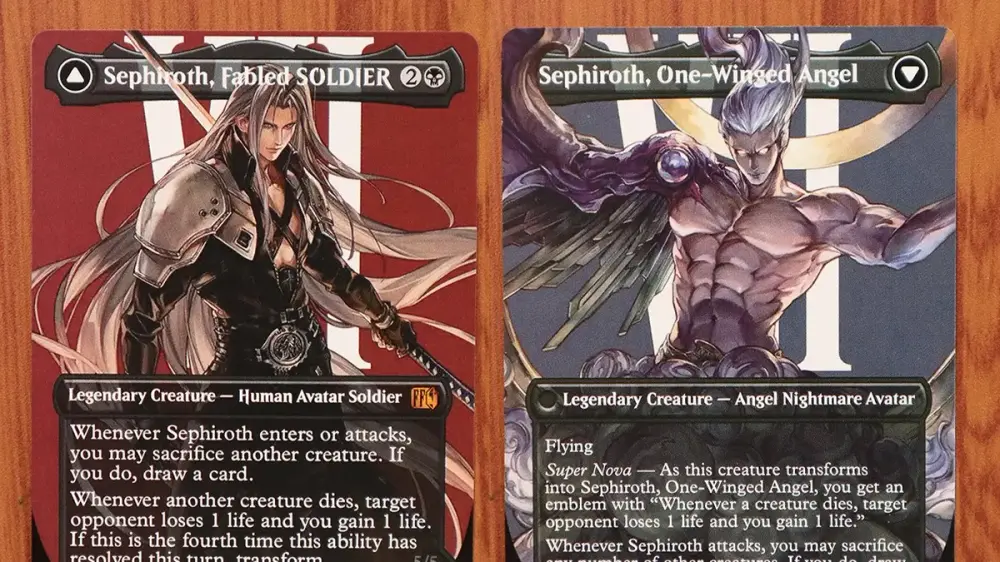
TLDR
MTG double-faced cards and meld are only “complicated” because your deck wants hidden information and your hands want convenience.
If you use opaque sleeves, life is easy: play the real two-sided card, flip it when it transforms, move on.
If you do not use opaque sleeves, use official substitute (checklist) cards so your deck is not accidentally marked.
On ProxyMTG, double-faced cards are automatically printed double-sided (front and back face). You do not need to order two separate cards.
Double-faced cards are confusion magnets. Not because the rules are secretly impossible, but because they combine the two things Magic players love most: hidden zones and physical objects you have to manipulate like you are doing close-up magic at a kid’s birthday party.
This guide is the clean, low-drama way to handle MTG double-faced cards and meld from ordering to gameplay, so you can spend your mental energy on important things, like deciding whether that two-land opener is “fine actually.”
What “double-faced” actually means (and why your decklist looks wrong)
A double-faced card (DFC) has two faces and no normal Magic card back. That is the whole reason they create friction: in a library, a card with a weird back is basically a glowing neon “THIS ONE” sign.
There are three common buckets:
1) Transforming or converting DFCs (the classic “flip it over”)
Think Werewolves, Sagas that turn into creatures, and various “do X, then transform” designs.
You cast/play the front face.
Later, the card transforms or converts and you physically turn it over.
In most hidden zones (library, hand, graveyard), the card is treated as its front face unless an effect says otherwise.
2) Modal double-faced cards (MDFCs)
These are the “pick a side” cards, like spell/land MDFCs.
You choose which face you are playing or casting when you play/cast it.
Once it is on the stack or battlefield, it only has the characteristics of the face that is up.
In hidden zones, rules still lean on the front face for many characteristics, which matters for weird edge cases and rules questions.
3) Meld cards (two cards that become one big card)
Meld is the one that makes people squint, because it is literally two separate cards that can combine into a single oversized permanent.
You need both specific cards on the battlefield.
An effect exiles them and they return melded as one permanent using the combined back face.
It is dramatic, it is clunky in sleeves, and it is still worth it when you live the dream.
If you want a broader “make proxies readable, not cute” philosophy that also applies to DFCs, this post is the vibe: Magic design changes for proxy players.
Ordering MTG double-faced cards and meld on ProxyMTG (without spreadsheet energy)
Here is the part that should not be stressful, and on ProxyMTG it is not.
Double-faced cards
On ProxyMTG, if you select a DFC, we automatically print both sides. Your card arrives as an actual two-sided card (front face and back face), not a “normal back” stand-in. So you are not juggling “front proxy” plus “back proxy” like it is 2009 and you are cutting paper in your kitchen again.
Practical ordering notes:
Order the card once. Do not add the back face separately.
If your decklist importer shows the “front name” only, that is normal.
If your list uses the “Card // Card” format, that is also normal. The card is still one physical DFC.
Meld cards
Meld is the exception, because it is two separate cards.
Add both front-face cards to your order.
Each one will be printed double-sided, which is what you want, because the combined face is formed by those two backs coming together.
If you are also doing cubes or “I update this list weekly” projects, you will probably like this companion piece: MTG proxying a cube.
Playing MTG double-faced cards cleanly (the “nobody has to ask twice” method)
The goal is simple: your opponents should never wonder if your deck is marked, and you should never have to pause the game to do arts and crafts.
Step 1: Pick your sleeve reality
If you use opaque-backed sleeves:
Put the two-sided DFC in your deck like a normal card.
When it transforms, take it out, flip it, put it back.
Done. You are living in the blessed timeline.
If you do not use opaque sleeves (clear sleeves or no sleeves):
Use official substitute/checklist cards in your deck.
Keep the real DFC off to the side.
When you play the substitute, swap in the real DFC for the battlefield.
When it goes back to a hidden zone, swap back to the substitute.
This is not just “nice etiquette.” It is the rules solution for “do not accidentally mark your deck.”
Step 2: Make the back face readable in real play
Even in opaque sleeves, DFCs can slow games down if the back face is hard to parse. Two small habits help a lot:
Announce the transform like a normal game action: “Transforming this into X.”
Place it consistently (same orientation, same spot) so people track it easily.
If you play on camera (SpellTable, webcam pods), pick versions where the name line and type line are easy to read. Full-art vibes are fun until your table turns into a cooperative OCR project.
Step 3: Bring the tiny “DFC kit”
This is the stuff that prevents mid-game rummaging:
A day/night marker if your deck can create day/night
Any tokens your DFCs make commonly
A pen and 1–2 blank cards (or a note card) for quick references
If you run meld: one “meld reference” solution (see next section)
That is it. Anything beyond that is just you collecting accessories to avoid making deck cuts. We have all been there.
Meld cards without making everyone remove sleeves
Meld is the mechanic most likely to cause a full stop while someone says, “Wait, how does this work again?”
Here are two clean options. Pick one and stick to it.
Option A: The “rules literal” method (fine, but fiddly)
When the meld happens, remove both cards from sleeves, turn them over, line them up as the oversized permanent.
When it leaves, split them, sleeve them again, put them where they belong.
It is correct. It is also the fastest way to learn that resleeving mid-game is a personal test of patience.

Option B: The “casual table” method (recommended for sanity)
When the meld happens, keep the two cards together off to the side (or tucked under a single card) to show they are linked.
Put a single reference card on the battlefield to represent the melded permanent (clearly labeled as a reference).
When it leaves the battlefield, remove the reference and move the two real cards to the correct zone(s) as the rules dictate.
This keeps the board state legible and avoids sleeve gymnastics. In casual play, clarity beats theatrical accuracy.
One extra note: meld has weird corner cases with replacement effects and zone changes. If your pod is the kind that enjoys that sentence, you probably already know where the Comprehensive Rules PDF lives.
FAQs
Do I need to order both sides of a DFC separately?
No. On ProxyMTG, double-faced cards are printed double-sided automatically. Order the card once.
Do I have to use sleeves for DFCs?
If you want to avoid marked-card issues, yes, you need opaque sleeves or you need to use official substitute/checklist cards.
How do meld cards work in an order?
Order both front-face cards in the meld pair. They are two separate cards, and you need both.
Can I use substitute/checklist cards with proxies?
In sanctioned tournament rules, substitute cards have specific requirements and are meant to represent real double-faced cards. For casual proxy play, the principle still holds: hidden zones should not be identifiable, and your table should always know what is what.
What is the cleanest way to handle meld in sleeves?
Use a labeled reference card for the melded permanent and keep the two real cards together as the “source.” Your pod will thank you, even if they never say it out loud.