
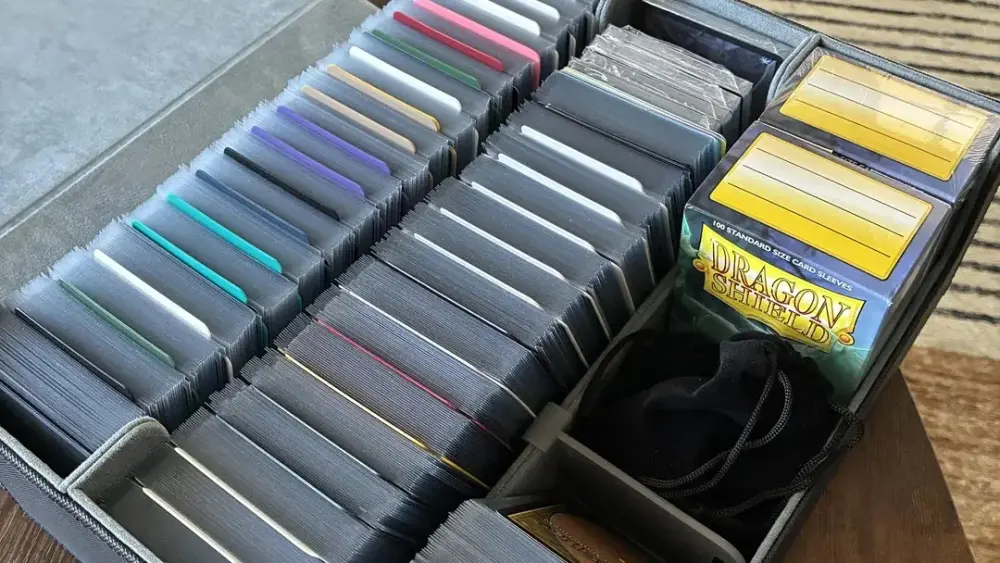
TLDR
MTG Jumpstart Cube proxies let you build a permanent library of 20-card themed packets that can be mixed into instant 40-card decks.
For a first box, I recommend 16 packets, or 320 cards. That gives you 120 possible two-packet combinations without creating a storage project that requires its own zoning permit.
Build each packet to function independently. Include its own lands, threats, interaction, mana curve, and a clear theme.
Proxies make particular sense for Jumpstart because you may want multiple copies of useful cards across different packets, and experimentation is half the point.
Keep one master packet list and update individual packets instead of rebuilding the entire box.
Jumpstart has one of Magic's better ideas hiding inside an ordinary booster wrapper: take two small themed decks, smash them together, and play.
MTG Jumpstart Cube proxies take that idea and make it reusable. Instead of opening disposable Jumpstart boosters, you build a permanent box of 20-card packets. Pick two, shuffle them together, play a 40-card deck, separate them afterward, and return both packets to the box.
No draft setup. No deckbuilding before game night. No staring at your Commander deck for 45 minutes deciding which seven-drop has finally disappointed you enough to get cut.
And because the packets are reusable, a relatively small collection can produce a lot of different games.
What Is a Jumpstart Cube?
A normal MTG cube is usually one large pool of individual cards that players draft.
A Jumpstart cube works differently.
The packet is the basic unit.
Each packet contains 20 cards built around a recognizable theme. Wizards' original Jumpstart products use exactly this structure: each booster contains 20 cards, including lands, and two packets combine into a playable 40-card deck. Wizards' designers have also described the packets as miniature theme decks containing creatures, interaction, finishers, lands, and an appropriate mana curve.
Your reusable version keeps that concept but removes the random sealed-product part.
For example, your box might contain packets called:
Goblins
Zombies
Flyers
Elves
Sacrifice
Treasure
Auras
Spells
Reanimator
Artifacts
Lifegain
+1/+1 Counters
Grab Goblins + Treasure and you have one deck.
Next game, shuffle Goblins + Reanimator together.
That deck may be less dignified. It may also be fantastic.
Why Proxies Fit a Jumpstart Cube So Well
Jumpstart is almost suspiciously well suited to proxies.
When you build a normal Commander deck, you need one finished list.
When you build a Jumpstart box, you're effectively building many small decks that need to work in dozens of combinations. You may want the same broadly useful removal spell, tribal piece, land, or utility card in several packets.
Buying a separate physical copy every time quickly becomes less charming.
Proxies also make experimentation easier.
Maybe your first Zombies packet is too slow. Maybe Auras becomes terrifying whenever paired with White Weenie. Maybe one card looked clever in the spreadsheet but turns out to be the sort of clever that makes everyone ask who invited it.
Swap the card and print the replacement.
That modularity is one of the biggest reasons to proxy a cube in the first place. Our guide to proxying an MTG cube uses the same basic philosophy: maintain a master list, make controlled updates, and avoid reprinting everything whenever you change your mind.
How Many Jumpstart Packets Should You Build?
You do not need 50 packets to start.
In fact, I would strongly recommend that you don't.
A smaller environment is much easier to balance because you can actually play the combinations instead of merely admiring the tremendous administrative achievement sitting on your shelf.
My pick: 16 packets
Sixteen is the sweet spot for a first Jumpstart cube.
You get:
320 total cards
enough packets for eight players
120 possible pairings
enough room for color and strategy variety
a box you can realistically test
You can always add four more packets later.
That is considerably easier than building 40 on day one and discovering Packets 31 through 40 were designed during whatever emotional event occurred around midnight.
The Most Important Rule: Every Packet Must Stand on Its Own
A Jumpstart packet cannot assume its other half will rescue it.
If your "Graveyard" packet has several reanimation spells but no reliable way to put creatures into the graveyard, it is not a packet. It is a cry for assistance.
Every packet should contain enough structure to contribute to a functional deck regardless of what it gets paired with.
Wizards has described successful Jumpstart packets as containing their own lands, creatures, interaction, finishers, and sensible mana curve.
That gives us a useful design checklist.
A Practical 20-Card Packet Framework
You do not need to use identical ratios in every packet, but this is a good starting point:
7 to 8 lands
Enough mana for the packet to support its half of a 40-card deck.
Mostly basics are easiest.
Special lands can support the theme, but be cautious with lands that only work when another specific card appears.
8 to 10 threats or creatures
Your packet needs things that actually advance the game.
Control-oriented packets can use fewer creatures if they contain other realistic win conditions.
2 to 4 interaction or support cards
Examples include:
creature removal
combat tricks
counterspells
artifact or enchantment interaction
card selection
protection
bounce
The exact mix depends on the theme.
1 to 3 payoff cards
These are the cards that tell the player what the packet is trying to do.
Your Goblins packet should have something that rewards Goblins.
Your +1/+1 Counters packet should have something that rewards counters.
Your "Creatures With Hats" packet is between you and your god.
The main point is that a player should understand the theme after seeing a few cards.
Build Themes That Combine Well
The hardest part of designing a Jumpstart cube is not making an interesting packet.
It is making an interesting packet that still works when paired with 15 other packets.
That changes how you should design.
Good Jumpstart themes are additive
Suppose you build a green +1/+1 Counters packet.
Its cards work normally by themselves. But pair it with:
White Tokens, and you get lots of creatures to grow
Blue Flyers, and counters make evasive threats larger
Black Sacrifice, and creatures can become useful resources
Red Aggro, and suddenly everything is trying to end the game immediately
The theme adds something without demanding a particular partner.
Be careful with parasitic themes
A packet that requires extremely specific support can produce dead combinations.
For example, imagine a packet where half the cards specifically care about Equipment, but the packet only contains one Equipment.
Pairing it with another packet probably doesn't solve the problem.
That theme needs enough internal support first.
A useful rule is:
If a packet needs a certain permanent, creature type, or graveyard condition to function, put enough of that resource inside the packet itself.
The second packet should create bonuses, not life support.
Start Mostly Monocolor
You can absolutely build multicolor Jumpstart packets.
I would not start there.
Monocolor packets are easier because each half provides roughly half the mana base. Combine red and blue, and suddenly you have a reasonable Izzet deck without thinking too hard about it.
That is a feature.
A three-color result generated by combining two multicolor packets can also work, but now your mana base needs more attention.
For a 16-packet starter cube, a clean structure might be:
White
Go Wide
Auras
Lifegain
Blue
Flyers
Wizards
Spells
Black
Zombies
Sacrifice
Graveyard
Red
Goblins
Burn
Treasure
Green
Elves
+1/+1 Counters
Big Creatures
Colorless
Artifacts
That is not a sacred list. It is simply broad enough that most combinations should create understandable Magic decks.
And understandable matters.
Jumpstart should get players into games quickly. If combining two packets requires a 14-minute seminar on the stack, we may have wandered away from the premise.
Avoid Making Every Packet a Good-Stuff Deck
There is a temptation when designing packets to start with the best cards.
Don't.
If every red packet contains the same premium burn package and every blue packet contains the same counters and card draw, the box starts becoming one deck wearing 16 novelty hats.
Packet identity needs room.
Let some cards be slightly narrower because they make the theme stronger.
For example:
Goblins gets tribal payoffs.
Sacrifice gets fodder and sacrifice outlets.
Auras gets enchantment-specific support.
Artifacts gets artifact synergies.
Graveyard gets discard and self-mill.
The goal is not maximizing the power level of every individual card.
The goal is maximizing the number of fun combinations.
Those are not always the same thing. Magic has spent 30 years teaching us this lesson and we remain optimistic.
Proxy the Whole Box or Just the Expensive Cards?
For a Jumpstart cube, I prefer proxying the entire box consistently.
You can mix authentic cards and proxies, especially when everything is sleeved. But an all-proxy environment has some practical advantages:
consistent cardstock
consistent thickness
consistent card backs
easier replacement
no need to remember which packet borrowed your real copy
simpler future updates
If you already own piles of basics, you can obviously use them.
But I would avoid constantly moving expensive cards between packets.
A permanent Jumpstart box is much more pleasant when each packet is genuinely complete.
Nobody wants to hear:
"Hang on, the Elves packet needs the card currently inside Sacrifice."
We have reinvented deckbuilding, which Jumpstart was specifically trying to prevent.
Keep the Art and Frames Readable
A Jumpstart cube gets shuffled together in combinations players may not have seen before.
Readability matters.
Special treatments and alternate art are fun, but I would prioritize:
recognizable card name
readable mana cost
clear card type
readable rules text
consistent sizing and finish
If you want your whole cube in old frames, great.
If you want full-art basics for each theme, also great.
Just avoid turning every packet into a graphic design experiment.
A reusable game piece needs to work at arm's length across a table, not merely look impressive while occupying 1,200 pixels on a monitor.
Give Every Packet a Theme Card
Make a simple divider or theme card for each packet.
It should show:
Packet name: Goblins
Color: Red
Difficulty: Easy
Style: Aggressive creature deck
Version: 1.2
You can optionally include a one-sentence description:
Build a Goblin army, attack early, and use direct damage to finish the job.
That helps new players choose quickly without reading all 20 cards.
It also makes rebuilding packets much easier after a game.
Because eventually someone will ask, "Does this Mountain belong to Goblins or Treasure?"
And somehow seven adults will stare at it like archaeological evidence.
Store Each Packet Separately
You need to be able to:
grab a packet
shuffle it with another packet
play
separate the cards
put both packets back
Small deck boxes, reusable card packs, or dividers inside a larger card box all work.
The specific container matters less than labeling.
I would also give each packet a tiny identifying mark on its theme card or organizational sleeve system so that reconstruction is painless.
You should not need to memorize the complete contents of sixteen packets.
That is what spreadsheets are for. They enjoy suffering.
Maintain One Master Packet List
This is the most important long-term organizational rule.
Use a spreadsheet or deck-management tool and keep one source of truth.
For each packet, track:
packet name
color
version
20-card list
theme
cards added
cards removed
notes from testing
Then treat changes like software updates.
Example
Goblins v1.1
Out
1 slow five-drop
1 narrow tribal trick
In
1 two-drop Goblin
1 flexible burn spell
Reason
Packet repeatedly stumbled when paired with slower themes.
That is much better than rebuilding Goblins from memory six months later because you apparently once believed Future You would be organized.
Future You is busy.
How to Print a Jumpstart Cube Efficiently
Once your packet lists are stable, combine them into one clean order list.
If you have 16 packets, that means 320 cards.
Before ordering:
confirm every packet has exactly 20 cards
verify quantities for cards appearing in multiple packets
check artwork and printing selections
make sure lands are included
decide whether you want packet-specific basics
order spare theme cards or tokens separately if needed
ProxyMTG's print MTG proxies workflow lets you assemble larger card batches without needing to manufacture and cut hundreds of cards yourself.
And this is exactly the sort of project where batching makes sense.
Three proxies on printer paper is a craft project.
Three hundred and twenty individually cut cards is a lifestyle choice.
My Recommended First Jumpstart Box
If I were starting today, I would build:
16 packets
20 cards each
mostly monocolor themes
320 cards total
consistent proxies throughout
opaque sleeves
one labeled divider per packet
one spreadsheet containing every packet
no packet changes until after at least three or four play sessions
That last rule matters.
Do not rebalance a packet every time it loses.
Sometimes Goblins loses because Goblins drew four Mountains and stared at them.
That is not necessarily a design problem. That is Magic.
Collect enough games to identify patterns before making changes.
Once the core environment feels good, add four packets at a time.
Your reusable Jumpstart box can eventually become enormous if you want it to.
Just make sure every new packet contributes a genuinely different experience.
Variety is the point.
Otherwise you have simply built a 600-card storage solution.
FAQs
How many cards are in a Jumpstart packet?
Official Jumpstart packets contain 20 Magic cards, including lands. Two packets are combined to produce a 40-card deck.
How many packets should an MTG Jumpstart cube have?
I recommend starting with 16 packets. That is 320 cards and provides 120 possible two-packet combinations while remaining manageable to balance and store.
Can I build a Jumpstart cube entirely with proxies?
Yes. For a casual reusable box, proxies are particularly convenient because you can keep every packet permanently assembled and print duplicates when the same card belongs in multiple themes.
Should Jumpstart packets be the same color?
Each individual packet is easiest to build as one color, especially in a first cube. Combining two packets then naturally creates one-color or two-color decks. More complicated multicolor packets can be added later.
Do I need to copy official Jumpstart decklists?
No. You can use official packets, modify them, or build entirely custom themes. The important part is keeping each packet self-contained enough to combine with the rest of your box.
Should every Jumpstart packet have exactly the same number of lands?
Not necessarily. Different curves and mechanics can justify different land counts. The important part is that each packet contributes enough mana for the combined 40-card deck to function reliably.
References
Wizards of the Coast, Introducing Jumpstart: A New Way to Play Magic. Wizards established the core two-packet structure, with 20-card themed boosters combined into 40-card decks.
Wizards of the Coast, Behind the Scenes of Designing Jumpstart. Discusses packet construction, including lands, creatures, interaction, finishers, mana curves, and alternate Jumpstart play methods.
Wizards of the Coast, Foundations Jumpstart Booster Themes. Confirms the continuing 20-card packet and two-packet deck structure in Foundations Jumpstart.
ProxyMTG, MTG Proxying a Cube: Keep It Updated Without Reprinting Your Life Story. Covers master-list management, consistent proxy construction, and incremental cube updates.