
TLDR
Premodern proxies are a natural way to build a permanent collection of classic decks without buying multiple copies of older staples for every list.
Premodern uses a community-created card pool running from Fourth Edition through Scourge, roughly covering Standard-era Magic from 1995 through 2003.
Do not build a gauntlet by picking eight variations of your favorite strategy. Build it around matchup coverage.
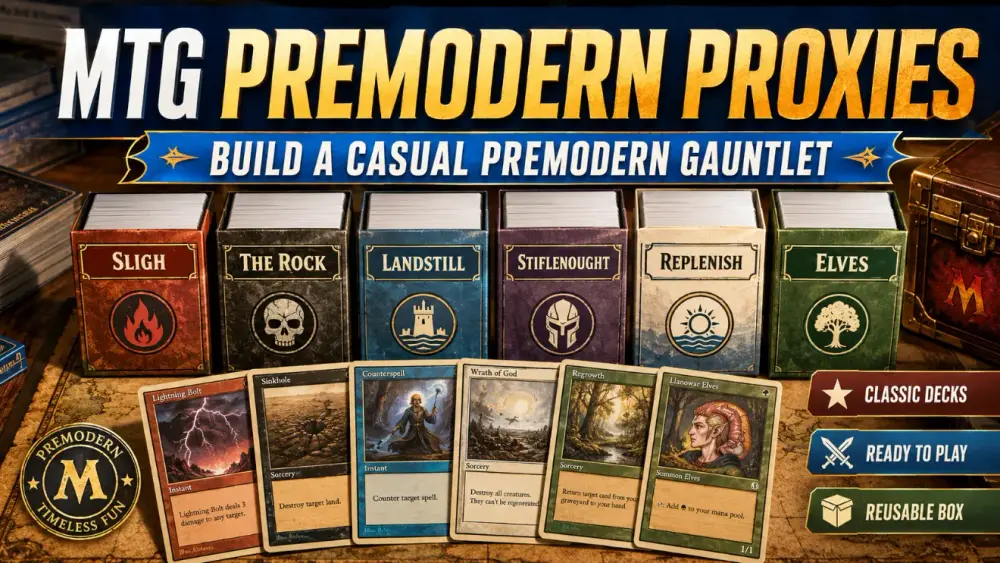
A strong first six-deck gauntlet is Sligh, The Rock, UW Landstill, Stiflenought, Replenish, and Elves.
Expand to eight by adding Goblins and Enchantress.
Keep every deck permanently assembled, including sideboards. Cannibalizing one deck to build another defeats most of the point.
Premodern is what happens when you take one of Magic's most nostalgic periods, give it a carefully defined card pool, and then let several decades of players figure out everything those cards were secretly capable of doing.
It is also an extremely natural home for Premodern proxies.
A single old deck is one thing. A proper Premodern gauntlet might contain six or eight complete 60-card decks, sideboards, duplicated lands, repeated staples, and enough old cardboard to make the cashier at your local card shop start asking unusually personal questions about your financing.
For casual testing and game nights, proxies let you build the whole environment instead.
And that is where Premodern gets really good.
What Is Premodern MTG?
Premodern is a community-created Magic format designed around cards from a specific period of the game's history.
The card pool runs from Fourth Edition through Scourge.
A useful shorthand from the format's official site is old-frame cards from roughly 1995 through 2003 that were Standard legal during that period, although the actual legal-set list is the thing to follow rather than trying to perform archaeological carbon dating on every card frame.
Premodern uses contemporary Magic gameplay rules and maintains its own banned list.
This produces a card pool full of cards many longtime players remember immediately:
Lightning Bolt
Swords to Plowshares
Counterspell
Survival of the Fittest
Mishra's Factory
Goblin Lackey
Psychatog
Replenish
Cursed Scroll
Phyrexian Dreadnought
Fact or Fiction
Mox Diamond
The result feels recognizably old-school without being frozen into one exact year.
And importantly, Premodern has developed its own metagame.
It is not simply "replay an Extended deck from 2001 and hope for the best."
Why Build a Premodern Gauntlet?
A gauntlet is a collection of complete decks built to represent different strategies and matchups within a format.
Instead of owning one Premodern deck, you might keep six or eight.
Then game night becomes:
"Pick a box."
That is it.
No deckbuilding. No borrowing four cards from Deck A so Deck B can exist. No reconstructing a sideboard from a deck photo you bookmarked nine months ago.
This is especially useful if:
you want to teach Premodern to friends
you like switching decks
your group wants an occasional nostalgia night
you want to learn matchups
you want to test new Premodern brews
you simply enjoy owning a small playable snapshot of a format
A gauntlet is basically a board game built out of complete Magic decks.
Except the board game has Cursed Scroll in it, so everyone should remain vigilant.
Why Premodern Proxies Make Sense for a Gauntlet
The proxy argument gets much stronger when you move from one deck to eight.
Suppose several decks need the same lands or format staples.
If you only own one playset, you have three choices:
Buy more copies.
Constantly move cards between decks.
Keep each deck complete using proxies.
For a casual gauntlet, option three is wonderfully boring.
And boring is good here.
A gauntlet should be available when you want to play it.
If getting started requires opening four deck boxes, locating eight missing cards, checking a binder, and asking whether anyone remembers where the fourth City of Brass went, you don't own eight decks.
You own eight partially completed administrative requests.
The Big Rule: Build for Matchup Coverage
This is the most important recommendation in this article.
Do not choose gauntlet decks based only on which decks you personally want to play.
Choose decks that ask different questions.
A useful Premodern gauntlet should include some combination of:
fast aggro
tribal or creature synergy
midrange
traditional control
combo
tempo-combo
engine decks
prison or enchantment strategies
You want each deck to force the others to interact differently.
If all eight decks are slow midrange piles, you have not built a gauntlet.
You have built a very specific weekend.
The Six-Deck Premodern Starter Gauntlet
If I wanted to introduce a group to Premodern without printing an entire warehouse, I would begin here.
1. Sligh
Role: Fast aggro and burn
Sligh gives the gauntlet a clock.
It attacks quickly, pressures life totals, punishes stumbling mana, and forces slower decks to prove they can actually stabilize rather than merely having written "good late game" in their deck description.
Typical Sligh cards include aggressive one-drops, efficient burn, Cursed Scroll, and Fireblast.
Why include it?
Because every gauntlet needs a deck that asks:
"What exactly were you planning to do before turn five?"
That is valuable information.
2. The Rock
Role: Midrange
The Rock gives you interaction, creatures, disruption, and long-game resource battles.
It represents the classic midrange idea of answering threats while deploying cards that generate enough value to eventually take over.
This is a great gauntlet deck because it has meaningful games against almost everything.
It also teaches one of Premodern's most important lessons:
Playing individually powerful cards does not relieve you of the unfortunate obligation to make decisions.
3. UW Landstill
Role: Traditional control
A gauntlet needs a control deck.
UW Landstill brings countermagic, removal, card advantage, sweepers, Standstill, and creature lands into one very recognizable control shell.
This is the deck you use to test whether another strategy can:
develop without overextending
fight through countermagic
beat sweepers
create threats without handing away cards
close a game before the control player becomes emotionally comfortable
It also provides the proper old-school experience of staring at untapped Islands and wondering whether anything good has ever happened.
4. Stiflenought
Role: Tempo-combo
Stiflenought uses cards such as Stifle or Vision Charm with Phyrexian Dreadnought to produce a very large creature for very little mana.
That gives your gauntlet something fundamentally different.
It can threaten a fast, compact combo while still playing blue interaction.
Testing against it teaches players to respect:
timing
countermagic
combo disruption
cheap threats
efficient answers
A format feels much deeper once not every dangerous deck announces its intentions by spending seven mana.
5. Replenish
Role: Engine or combo-control
Replenish gives your gauntlet an enchantment-based engine deck.
Rather than simply attacking efficiently or countering everything, Replenish builds around loading enchantments into the graveyard and bringing them back together.
It attacks from a different axis, which is exactly what you want.
One practical note: use a current Premodern list when constructing this deck rather than blindly copying an older tournament list. Premodern maintains its own banned list, and old lists can become obsolete.
Printing 75 beautiful cards and then discovering List.txt is a historical document is one of the less exciting forms of nostalgia.
6. Elves
Role: Creature engine
Elves is technically an aggressive creature strategy, but it plays very differently from Sligh.
Instead of burn and raw speed, Elves builds a board, produces mana, and uses creature synergies to generate increasingly rude amounts of cardboard.
It tests:
sweepers
spot removal
board interaction
creature combat
engine disruption
This matters because "aggro" is too broad a category.
Sligh and Elves may both want your life total to reach zero, but their route planning is entirely different.
The Eight-Deck Premodern Gauntlet
Once the six-deck version is working, I would add these.
7. Goblins
Role: Tribal aggro and value
Why add Goblins when you already have Sligh and Elves?
Because Goblins attacks differently from both.
It can open aggressively, but tribal synergies and cards that generate value let the deck continue operating later into games.
Goblins gives you a deck where creature type matters heavily and where individual cards can dramatically change how the board develops.
It is one of the classic strategies associated with the era for good reason.
Also, Goblin Lackey has never met a turn-one combat step it didn't view as a career opportunity.
8. Enchantress
Role: Engine, control, or prison
Enchantress rounds out the box beautifully because it plays on a completely different axis.
Rather than relying on conventional creatures and removal exchanges, it develops enchantments and card-draw engines that can make ordinary interaction look embarrassingly unemployed.
This gives your gauntlet another question:
Can your deck interact with permanents other than creatures?
If the answer is no, Enchantress will be pleased to conduct the demonstration.
A Balanced Premodern Gauntlet at a Glance
DeckStrategic RoleWhat It TestsSlighFast aggroSpeed, life total, early interactionThe RockMidrangeResource battles, disruptionUW LandstillControlPatience, card advantage, resilient threatsStiflenoughtTempo-comboTiming, cheap answers, stack interactionReplenishCombo-engineGraveyard and enchantment interactionElvesCreature engineSweepers, board controlGoblinsTribal aggroCreature synergy, sustained pressureEnchantressEngine/controlNoncreature interaction
That is a much more useful spread than simply choosing eight famous decklists.
A gauntlet should cover problems, not popularity.
Other Premodern Decks Worth Rotating In
Eight decks is not a prison sentence.
Once you know the format, rotating decks keeps the box fresh.
Strong candidates include:
Psychatog
UG or GW Madness
Reanimator
Survival variants
Stompy
Suicide Black
Oath strategies
various artifact or prison decks
different Standstill shells
The Premodern community has produced an enormous range of archetypes over the years, and recent format discussion continues to feature strategies such as Elves, Sligh, Replenish, Goblins, Dreadnought, Enchantress, Landstill, Psychatog, Madness, and Rock-style decks.
You are not trying to preserve every Premodern deck ever built.
You are building a playable exhibit.
Leave some room in the museum basement.
Should You Include Sideboards?
Yes, eventually.
If your goal is casual pick-up games, starting with the 60-card main decks is completely reasonable.
That lets everyone learn:
what the decks do
which threats matter
how the matchups feel
which decks they actually enjoy
But once the gauntlet becomes a regular thing, I would add full sideboards.
Sideboarding changes matchups substantially and gives many specialized cards a reason to exist.
More importantly, a deck box containing a complete 75-card list is much easier to maintain than:
"These thirteen cards are definitely the sideboard. I think two others are in the blue box."
We have enough mysteries.
Do Not Share Cards Between Decks
This is where proxies save the entire project.
If four decks use the same card, print four separate playsets if necessary.
The whole advantage of a gauntlet is permanence.
Every box should be ready to play.
Do not create a spreadsheet saying:
Move 4 cards from Landstill to Stiflenought, unless Dave is playing Landstill, in which case borrow 2 from Psychatog.
That is not a Magic format.
That is enterprise resource planning.
Duplicate your shared staples and leave every deck intact.
Keep the Decks Visually Consistent
Premodern has a strong aesthetic identity, and plenty of players understandably like old-frame cards.
You can absolutely lean into that.
For proxies, however, I would prioritize readability before strict aesthetic purity.
Pick versions with:
clearly readable card names
recognizable artwork
readable mana costs
complete rules text
consistent sizing
consistent print quality
If you want every card using an old frame, great.
If you prefer newer printings because the text is easier to read, that is also practical for a casual gauntlet.
The gauntlet should encourage people to try unfamiliar decks.
Making them decipher sixteen alternate-art treatments before game one is not helping.
Use One Decklist Source of Truth
Every gauntlet deck should have a saved decklist.
Record:
deck name
main deck
sideboard
source
version or date
any personal changes
Premodern is an active community format, and lists evolve.
If you see a cool current build, save the exact list you printed.
Do not rely on remembering which version you used.
The MTG decklist to printed proxies workflow walks through cleaning and checking larger lists before import, which becomes particularly useful when you're ordering several decks at once.
For a gauntlet, I would use names such as:
Sligh v1
Rock v1
Landstill v1
Stiflenought v1
Replenish v1
Elves v1
When you make changes, update the version.
Simple.
Boring.
Magnificent.
Print Decks in Batches
Six complete 75-card decks means 450 cards.
Eight complete 75-card decks means 600.
That is large enough that a clean batch workflow becomes important.
Before submitting anything:
Confirm every main deck contains the intended number of cards.
Confirm every sideboard.
Check duplicated card quantities.
Verify the card versions and artwork.
Add commonly used tokens if desired.
Label your deck lists before combining them into one order.
Spot-check every imported list.
ProxyMTG's print MTG proxies service makes more sense for a project like this than treating each deck as a separate arts-and-crafts episode.
The goal is to own a Premodern gauntlet.
The goal is not to become extraordinarily good at operating a paper trimmer.
How to Test Your Premodern Gauntlet
Do not worry about perfectly balancing every matchup.
Constructed Magic is not supposed to create eight decks that are all exactly 50/50 against each other.
Instead, look for obvious problems.
Ask these questions
Does every deck have at least a few reasonable matchups?
Is one deck overwhelmingly stronger than the rest?
Is one deck so complicated that nobody chooses it?
Do you have enough strategic variety?
Are games ending in meaningfully different ways?
Are any lists badly outdated compared with your intended version of the format?
Keep notes for several sessions before changing anything.
A single 0-3 evening tells you almost nothing.
Magic players have spent decades losing three games and immediately identifying seventeen structural flaws in their deck.
Sometimes you just drew badly.
A Simple Gauntlet Night
For four players, put eight deck boxes on the table.
Have each player choose or randomly receive a deck.
Play a round.
Then rotate.
You can also use a winner-stays format, random deck assignment, or simply let people grab whichever strategy looks interesting.
The important part is that the barrier to starting another game is tiny.
Finish.
Swap boxes.
Shuffle.
Play.
That is where a Premodern proxy gauntlet shines.
You are no longer asking everyone to build and maintain a niche constructed deck individually.
The format lives in the box.
My Recommended Build
For most groups, I would begin with six decks:
Sligh
The Rock
UW Landstill
Stiflenought
Replenish
Elves
Play those for several nights.
Then add:
Goblins
Enchantress
After that, rotate individual decks instead of endlessly expanding.
Maybe Psychatog replaces Landstill for a month.
Maybe Madness replaces Elves.
Maybe somebody insists on Reanimator and immediately remembers why graveyard hate was invented.
The box can evolve without losing its identity.
That is the real advantage of building Premodern with proxies.
You aren't buying one expensive historical deck and hoping you love it forever.
You are building a reusable way to actually play the format.
FAQs
What sets are legal in Premodern MTG?
Premodern's card pool runs from Fourth Edition through Scourge. The official Premodern site maintains the complete legal-set and banned-card lists.
How many decks should be in a Premodern gauntlet?
Six is an excellent starting point. Eight gives you enough variety to represent aggro, midrange, control, combo, and engine strategies without creating an enormous maintenance project.
What are the best decks for a first Premodern proxy gauntlet?
I would start with Sligh, The Rock, UW Landstill, Stiflenought, Replenish, and Elves. Goblins and Enchantress are my next two additions.
Should I proxy entire Premodern decks or only expensive cards?
For a permanent gauntlet, proxying complete decks is simpler. It prevents individual cards from feeling different in sleeves and lets every deck stay permanently assembled.
Should a Premodern gauntlet include sideboards?
Eventually, yes. Main-deck-only games are excellent for learning the decks, but full sideboards give you deeper repeat matchups and let the decks operate as complete constructed lists.
Can I use modern card printings in a Premodern proxy deck?
For a casual gauntlet, choose whatever card presentation makes the game easiest for your group to read and play. Many players prefer old-frame aesthetics because they match the era, but readability is more important than turning game night into a typography exam.
References
Premodern Magic, About, Rules, Legal Sets and Ban List. The official format site defines Premodern as the community-created card pool running from Fourth Edition through Scourge and explains its overall format philosophy.
Premodern Magic, Deck Archetypes in Premodern. Provides a useful strategic classification of aggro, midrange, combo, control, and prison decks, along with historical Premodern examples.
Premodern Magic, Frantic Returns. Recent format discussion includes archetypes such as Elves, Sligh, Replenish, Goblins, Dreadnought, Enchantress, Landstill, Psychatog, Madness, and Rock/BW strategies.
Premodern Magic, Ban List Update 2026. The January 18, 2026 update banned Parallax Tide, illustrating why current decklists should be checked before building a permanent gauntlet.
ProxyMTG, MTG Decklist to Printed Proxies Workflow. Covers list cleanup, count verification, version selection, and batch importing for printed proxy decks.