

TLDR
Start with lands and fast mana. In Legacy and Vintage, the mana base is usually the expensive part, and the part you shuffle the most.
Readability is non-negotiable. These formats run cards with old wording, heavy errata, and stack spaghetti. Your proxies need to be clear enough that nobody has to “trust you, bro.”
Use Oracle text for complicated stuff. If the printed words on a card disagree with current rules text, the current rules text wins.
Sanctioned events are different. Player-made proxies generally are not allowed in sanctioned tournaments. Always ask the organizer for their policy.
Legacy and Vintage are the formats where your mana base can cost more than your deck box, your sleeves, and your sense of financial responsibility combined. If you’re making MTG proxies for Legacy and Vintage, the goal is simple: keep the games fast, fair, and readable, without turning every rules question into a courtroom drama.
Why Legacy and Vintage proxying is different
Legacy and Vintage are “Eternal” formats, meaning they pull from nearly all of Magic’s history. That creates two proxy problems you don’t feel as hard in newer formats:
First, the mana base is everything. Legacy leans hard on fetch lands plus original dual lands, plus utility lands like Wasteland that shape entire matchups. Vintage takes it further with restricted fast mana and archetypes built around specific lands like Bazaar of Baghdad or Mishra’s Workshop. You can proxy a few spells and still play Commander. In Legacy and Vintage, proxying the mana base is often the entire point.
Second, the cards are high-complexity on purpose. These formats reward tight sequencing, obscure interactions, and “this card has been errata’d since before you were born” text. If your proxy is hard to parse, it’s not a fun challenge. It’s just friction.
If you want a broader look at how the community drew the line between play pieces and deception over time, this is a good companion read: The History of MTG Proxies: From Playtesting to Modern Collectibles.
MTG proxies for Legacy and Vintage start with the mana base
If you’re proxying Eternal formats, proxy what you touch the most:
lands you fetch,
lands you Wasteland,
and the “oops I kept a one-lander with cantrips” hands you shuffle back into your deck five times a night.
That means your mana proxies need to solve two problems at once: gameplay clarity and physical consistency.
Mana base proxy checklist (practical, not romantic)
Uniform thickness: Keep your proxies physically consistent so they don’t become marked cards in disguise. If one “Tundra” is noticeably thicker or flimsier, everyone notices, even if nobody wants to accuse you out loud.
Opaque sleeves: Use sleeves that fully hide the back, and use the same sleeve type across the whole deck. (This matters more in formats where you shuffle constantly.)
Consistent versions: Pick one art or one frame style per land name when possible. Four different Underground Sea arts can look cool, but it also slows down fetch decisions and increases misplays.
Readable name and type line: For dual lands and fetch lands, the type line matters. “Island Swamp” isn’t flavor text, it’s the reason your fetchland works.
High-contrast text box: Lands get glanced at, not studied. If the name, mana abilities, and key text blend into the background, you’ve created a tiny recurring time tax.
Don’t get cute with lookalikes: A full-art land proxy that resembles a spell at a glance is how you end up with someone trying to Force of Will your Volcanic Island. Fun story later, annoying right now.
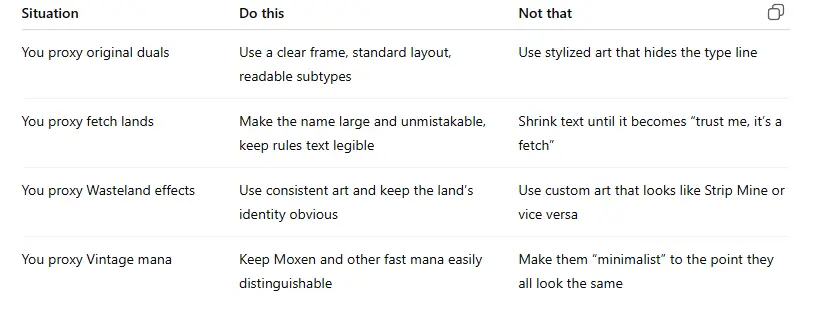
“Do this, not that” for mana proxies
A note on “mana base” in Vintage
In Vintage especially, “mana base” often includes fast mana artifacts. Treat them like lands for proxy standards: they’re early-game defining, they’re easy to misread across the table, and they can cause real disputes if they’re unclear.
If your table is proxy-friendly Vintage, your biggest win is making sure nobody has to ask “which Mox is that?” more than once per match.
High-complexity cards: print for the stack, not the vibes
Legacy and Vintage games involve more than turning creatures sideways. These formats are built around decision density: cantrip sequencing, stack interactions, replacement effects, weird timing windows, and cards whose printed text is basically a historical artifact.
That’s why high-complexity cards are the second proxy priority after mana. Your proxy needs to communicate the rules cleanly, because these formats punish misunderstandings.
Use Oracle text when complexity is high
For cards with heavy errata or famously confusing wording, Oracle text matters. Some classics have received meaningful updates over the years, and rules questions in Eternal formats often boil down to “what does the card say now?”
Practical translation: if you proxy a card like Time Vault, Chains of Mephistopheles, or anything else that has caused years of judge calls, don’t rely on old wording. Make the proxy reflect current rules text, or keep the Oracle text handy.
High-complexity proxy checklist (keep games moving)
Full rules text: Include the complete text when the card’s function is non-obvious. If the card is basically a combo engine, do not summarize it into two words and a prayer.
Readable mana cost: Eternal formats are full of tight resource decisions. If someone can’t read the cost instantly, you’ve slowed down the game.
Clear card name: Some lines of play involve naming cards, revealing, or searching. The name must be obvious.
Layout discipline: Keep the standard hierarchy: name, mana cost, type line, rules text. Your custom design instincts are valid, but this isn’t a poster contest.
Reference support: For truly gnarly cards, keep an Oracle reference available (phone is fine, a printed slip is even faster). The goal is to avoid “debate minutes.”
Token and marker plan: If the card creates tokens, counters, or delayed triggers, bring the markers. Vintage and Legacy don’t need extra confusion.
If you want more on why modern frame choices and readability matter (especially for split cards, double-faced cards, and dense text boxes), this fits nicely here: Magic design changes for proxy players.
Consistency and etiquette: don’t surprise people in Eternal formats
Proxy tolerance in Legacy and Vintage is wildly variable. Some groups are “proxy anything, we’re here to play.” Some are “proxy ten, pick your battles.” Some are “no proxies, this is a museum tour.” All three can be valid, as long as expectations are clear.
The 15-second conversation that saves the night
Here’s a script that works almost everywhere proxies are allowed:
“Quick heads-up: I’m running X proxies, mostly lands / fast mana, all in identical sleeves and fully readable. Is everyone cool with that?”
If you’re at an LGS, swap “everyone” for “the organizer” and ask before you sit down. Store nights often have house rules, and you don’t want to find out after you’ve shuffled.
Sanctioned events: don’t assume anything
Legacy and Vintage are sanctioned formats, but sanctioned tournament rules generally require authentic cards. There are narrow, judge-controlled exceptions for a damaged card during the event, but that is not the same thing as “I brought my own proxies.”
So: if it’s sanctioned, assume proxies are not allowed unless the event staff explicitly says otherwise.
Good, Better, Best: an Eternal proxy plan that stays sane
You don’t need a complicated system. You need a consistent one.
Good: Proxy the mana base (and fast mana if Vintage), keep everything readable, use opaque sleeves.
Better: Standardize versions (same art/frame per land name), keep Oracle text available for complex cards, and carry the tokens/markers your deck creates.
Best: Build an “Eternal staples kit” you can swap between decks (dual land suite, fetch suite, common sideboard cards), all printed in the same style and sleeved consistently, so you’re not rebuilding your proxy standards every time you change decks.
FAQs
Are MTG proxies for Legacy and Vintage allowed in tournaments?
In sanctioned tournaments, player-made proxies generally are not allowed. Judges can issue a proxy in specific situations (like accidental damage during the tournament), but players do not get to bring their own. For unsanctioned events, it depends on the organizer’s rules.
Should I proxy just the mana base, or the whole deck?
If budget is the constraint, the mana base is usually the highest impact place to start in Legacy and Vintage. If your goal is testing, proxying the whole deck can be fine, as long as your group is on board and the cards are readable.
Do I need the exact art and frame for Legacy/Vintage proxies?
No. In fact, chasing “perfect match” aesthetics is where people drift into bad territory. Prioritize clarity and consistency. The card should be obvious at a glance and not confused for something else.
What if a card’s printed text differs from what people say it does?
Use the current Oracle text. This comes up a lot with older cards and errata-heavy staples.
How many proxies are “reasonable” in Vintage?
There’s no universal number. Some Vintage events are run with a specific proxy limit (set by the organizer), while other groups are either fully proxy-friendly or fully proxy-free. Ask first, then build to that rule.