
TLDR
Guillotine cutters make excellent straight cuts through stacks of printed sheets. They are flexible, fast to set up, and perfectly sensible for prototypes and many short-run jobs.
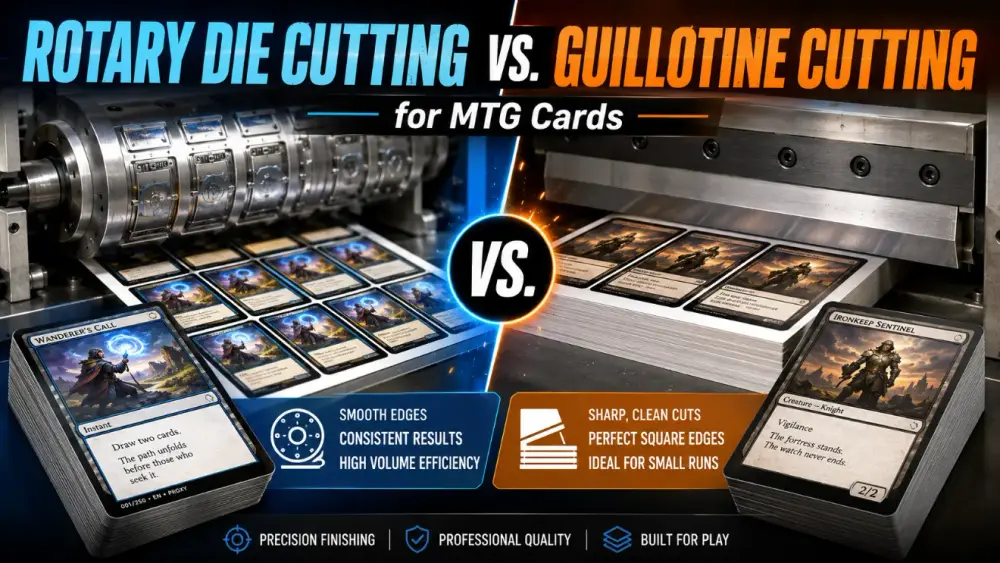
Rotary die cutters use a shaped die on a rotating cylinder, allowing the complete card perimeter and rounded corners to be cut repeatedly.
For MTG-style cards, rotary die cutting has a major advantage because rounded corners, final dimensions, and repeated card geometry can be handled as one controlled operation.
Modern rotary systems can use registration marks and X/Y adjustments to compensate for normal print-position variation.
Guillotine cutting is great when flexibility matters. Rotary die cutting is usually the stronger choice when thousands of cards need to emerge looking suspiciously like they all agreed on a size beforehand.
The easiest way to make a trading card feel homemade is to get the cutting slightly wrong.
Not wildly wrong. That would at least be interesting.
We mean the annoying kind of wrong. One card is half a millimeter wider. One corner has a different radius. Another has a visibly larger border on the left. Individually, none of these problems seem dramatic.
Stack 100 cards together and the deck starts developing topography.
That is why rotary die cutting cards deserves more attention than the subject usually gets. Printing gets all the glamour because artwork is colorful. Cutting waits at the end of the production line and quietly decides whether the finished card is actually the correct shape.
For MTG proxies and other trading cards, the two processes worth understanding are guillotine cutting and die cutting.
What Is Guillotine Cutting?
A commercial guillotine cutter uses a large straight blade to cut through a stack of paper or cardstock.
Modern professional versions are considerably more sophisticated than the paper cutter your teacher guarded with their life in elementary school.
A hydraulic production cutter can:
clamp large stacks
make programmed cuts
automatically reposition a back gauge
cut multiple sheets at once
repeat straight cuts efficiently
Duplo's HC-550i hydraulic cutter, for example, is designed for stacks of postcards, flyers, cards, and other commercial print work. The back gauge moves between programmed cuts while the operator rotates the printed stack as required.
For rectangular printed products, it is an extremely useful machine.
And MTG cards are rectangles.
Mostly.
Those corners have plans.
What Is Rotary Die Cutting?
A rotary die cutter works differently.
Rather than pushing a straight blade through a stack, the machine moves printed sheets through rotating cylinders. A custom cutting die attached to a magnetic cylinder contains the shape being cut.
As the sheet passes through, the die cuts the card outline.
That means the cutting tool can contain:
straight sides
rounded corners
unusual shapes
perforations
multiple cards positioned across one sheet
Commercial systems such as Duplo's UD-310 use interchangeable flexible magnetic dies and can process thousands of sheets per hour.
The important difference for trading cards is simple:
The die can define the entire finished card shape.
The card's corners no longer need to be somebody else's problem later.
Rotary Die Cutting Cards vs. Guillotine Cutting
Neither technology is inherently crude.
A good commercial guillotine cutter is a precision production machine.
The real question is whether straight-line stack cutting is the most efficient way to produce a trading card with four rounded corners.
Usually, it isn't.
The Guillotine Workflow for MTG Cards
Imagine a sheet containing a grid of MTG-sized cards.
Using a guillotine cutter, you might:
Trim the outer sheet.
Make the first set of vertical cuts.
Rotate or reposition the stack.
Make additional vertical cuts.
Rotate the pieces.
Make horizontal cuts.
Separate the finished rectangular cards.
Move them to a corner-rounding process.
Round all four corners.
This can work very well.
For a small number of cards, it may be the most sensible approach.
It is also why a basic paper trimmer is so useful for homemade proxies. Our homemade MTG proxy guide recommends a trimmer because straight guided cuts are dramatically cleaner than attempting to freehand everything with scissors while insisting you have "pretty steady hands."
But production volumes change the equation.
Every additional operation creates another place where:
pieces can shift
stacks can move
operators can make mistakes
tolerances can accumulate
labor gets added
And you still have to round the corners.
Why Rounded Corners Are More Important Than They Look
The corner radius of a card seems cosmetic until you stack a deck.
Then it becomes mechanical.
Rounded corners help cards:
enter sleeves more easily
avoid sharp points that catch on neighboring cards
stack consistently
resist some forms of corner damage
feel uniform in the hand
If you cut a card square on a guillotine and round the corners afterward, you have created a second finishing operation.
That is not automatically bad.
Dedicated playing-card production systems sometimes use multiple cutting and punching stages specifically because those systems are engineered around card packs.
Rollem's Revolution card production system, for example, performs automated cutting and collating before transferring decks into a punch that die-cuts the final rounded corners.
The lesson is not "guillotines bad."
The lesson is:
Professional cards need a controlled process for both dimensions and corners.
Ignoring half of the shape because it looked easy on the monitor is how manufacturing develops hobbies.
The Big Rotary Advantage: One Defined Shape
With a rotary die, the perimeter exists as a single tool geometry.
If the die is designed for the desired card size and corner radius, every cut follows that same geometry.
That gives rotary die cutting a natural advantage for repeated card production.
Instead of creating four straight edges and then separately creating four curved corners, the complete outline is formed as part of the die cut.
That can improve:
consistency
throughput
corner uniformity
finished appearance
labor efficiency
It also simplifies one of the most tedious truths in printing:
The printed image and the physical cut must agree about where the card is.
Print Registration Is Part of Cutting
Commercial presses do not place every image at a mathematically perfect coordinate on every sheet.
Paper moves. Stocks stretch slightly. Sheets skew. Feed systems have tolerances. Digital presses can exhibit small image-position shifts.
Normally those variations are tiny.
Trading-card borders are also tiny.
This is why finishing equipment often uses registration systems.
Duplo's UD-310 uses X and Y sensors to read registration marks and compensate for image shifting. Operators can also fine-tune alignment in 0.1 mm increments.
That matters for MTG-style layouts because a small cutting shift can produce visibly unequal borders.
The card can still be the correct overall dimensions while looking off-center.
This gives us two separate kinds of cutting consistency:
Dimensional consistency
Is every card physically the same size?
Print-to-cut registration
Is the printed card frame positioned correctly inside that physical shape?
You need both.
Otherwise you have manufactured a perfectly consistent set of incorrectly centered cards, which is technically impressive but not especially comforting.
Does Rotary Die Cutting Automatically Produce Perfect Cards?
No.
The machine still depends on:
accurate printed sheets
correct die geometry
proper registration
appropriate die pressure
material consistency
correct setup
maintenance
quality control
The substrate matters too.
A blade interacting with thin paper behaves differently from a blade cutting heavier coated cardstock.
Die condition matters over time as well. Cutting tools are physical objects, not immortal manifestations of geometry.
The advantage of rotary die cutting is not that tolerances stop existing.
The advantage is that the process is designed around controlling a repeated shape.
Where Guillotine Cutting Still Wins
There are situations where buying or creating a dedicated die makes absolutely no sense.
Prototypes
If you're testing three different card dimensions, a programmable guillotine is wonderfully flexible.
Change the cut dimensions and keep working.
A rotary die would require the appropriate tooling for each shape.
Very short runs
For a handful of rectangular cards, straight cutting plus a corner rounder can be perfectly practical.
There is no need to summon industrial machinery because you printed nine test cards.
Constantly changing dimensions
A guillotine can switch from postcards to cards to flyers using programmed measurements.
Rotary die cutting is strongest when the same shapes repeat.
Trading cards happen to repeat quite a lot.
A standard MTG deck is not famous for containing 100 subtly different card dimensions. Wizards has plenty of ways to surprise us already.
Where Rotary Die Cutting Wins for MTG Cards
Trading cards are nearly ideal candidates for die cutting because the shape is highly standardized.
You need:
the same width
the same height
the same corner geometry
the same general border relationship
the same result across large quantities
That is repeat manufacturing.
Rotary die cutting is built for repeat manufacturing.
For a professionally printed MTG proxy deck, consistency matters more than whether any individual card looks impressive by itself.
Take a single card out of a batch and a slightly inconsistent edge may be invisible.
Stack 100 together and your fingers can find things your eyes missed.
That is why cutting quality matters to:
deck stacking
sleeve fit
edge alignment
handling
overall perceived quality
Printing resolution gets the screenshots.
Cut consistency gets the actual deck.
Why Bleed Still Matters With Precision Cutting
Better cutting equipment does not eliminate the need for proper artwork preparation.
A full-bleed card design should extend beyond the final cut line.
Why?
Because no production system should depend on a printed background ending at precisely the same microscopic coordinate as a physical blade.
Bleed gives the cutter room to move within its acceptable tolerance without exposing an accidental white sliver along the finished edge.
This is true for guillotine cutting and die cutting.
Precision does not mean "zero tolerance."
Precision means the process has a controlled tolerance small enough for the product being manufactured.
Those are very different ideas, and commercial printing becomes much less mysterious once you stop expecting machinery to negotiate with atoms.
Good, Better, Best for Cutting MTG Proxies
Good: Hand cutting or basic trimmer
Best for:
fast playtests
a few cards
inserts going into sleeves
Tradeoff:
Expect more dimensional variation and manual corner work.
Better: Professional guillotine plus corner finishing
Best for:
short runs
prototypes
frequently changing dimensions
businesses already equipped for stack cutting
Tradeoff:
Cards require multiple finishing operations.
Best: Registered die cutting for repeat production
Best for:
complete decks
repeated standardized cards
commercial quantities
consistent corners and dimensions
Tradeoff:
Requires tooling, equipment, setup, and a production process designed around the die.
For standardized MTG-style cards, this is generally the approach I prefer.
How Cutting Fits Into the Rest of Card Quality
Cutting is only one piece.
A premium card workflow also needs:
suitable cardstock
accurate front-to-back printing
high-resolution image files
good color reproduction
controlled surface finishing
dimensional consistency
quality inspection
ProxyMTG's MTG proxy printing workflow combines premium black-core cardstock, print-file enhancement, UV coating, and precision die cutting.
That combination matters more than any individual buzzword.
Put poor artwork through an excellent cutter and you get accurately shaped blurry cards.
Put beautiful printing through inconsistent finishing and you get gorgeous cards that form a staircase when stacked.
Manufacturing has a sense of humor. It is not a generous one.
Rotary Die Cutting vs. Guillotine Cutting: Which Is Better?
For generic commercial printing, there is no universal winner.
For standardized trading cards, rotary die cutting has a strong advantage.
A guillotine excels at flexible straight-line cutting. It can process stacks efficiently, change sizes without new cutting dies, and handle enormous amounts of general print work.
A rotary die cutter is more specialized. But that specialization becomes useful when the product needs the same complete perimeter, including rounded corners, again and again.
For MTG cards, that is exactly the assignment.
So if I were choosing a cutting process specifically for repeat production of premium proxy cards, I would take registered die cutting.
Not because guillotine cutting is inaccurate.
Because trading cards are not merely small rectangles.
They are small rectangles that need to be the same small rectangle thousands of times.
Turns out cardboard appreciates commitment.
FAQs
Can you cut MTG cards with a guillotine cutter?
Yes. A professional guillotine cutter can produce very accurate straight cuts. Rounded corners will require an additional corner-rounding or punching step.
Why use rotary die cutting for cards?
Rotary dies can cut the full card perimeter, including rounded corners, using a repeatable shape. This makes the process especially useful for standardized card production.
Is rotary die cutting more accurate than guillotine cutting?
That depends on the equipment and the measurement being discussed. Professional guillotine cutters can make extremely accurate straight cuts. Rotary die cutting has an advantage when repeating a complete shape and when a system uses registration sensors to compensate for print-position shifts.
Does die cutting prevent off-center borders?
It can reduce the problem when the equipment includes print-to-cut registration controls, but it cannot fix every printing or artwork error. Accurate imposition and printing still matter.
Is guillotine cutting better for homemade MTG proxies?
Usually, yes. A small paper trimmer or guillotine-style cutter is inexpensive, flexible, and practical for small quantities. You can then use a separate corner rounder if desired.
Why does cutting consistency matter if the cards are sleeved?
Sleeves hide some small differences, but the underlying card still determines thickness, rigidity, dimensions, and how it sits inside the sleeve. Large dimensional differences can also become noticeable when a deck is stacked.
References
Duplo USA, UD-310 Rotary Die Cutter, specifications and production details covering flexible magnetic dies, business-card applications, registration sensors, 0.1 mm alignment adjustment, and production speeds up to 4,000 sheets per hour.
Duplo USA, HC-550i Hydraulic Cutter, specifications for programmable high-pile straight cutting, automatic back-gauge positioning, and card applications.
Rollem USA, Revolution Automated Card Cutting and Collating System, commercial playing-card and trading-card production system combining cutting, collating, registration compensation, and final rounded-corner die punching.
Duplo USA, UD-M300 Rotary Die Cutter, information on flexible dies, card applications, short-run production, and 0.1 mm cut alignment adjustment.
ProxyMTG, Print MTG Proxies, current production information covering premium cardstock, UV coating, print enhancement, and precision die cutting.