
TLDR
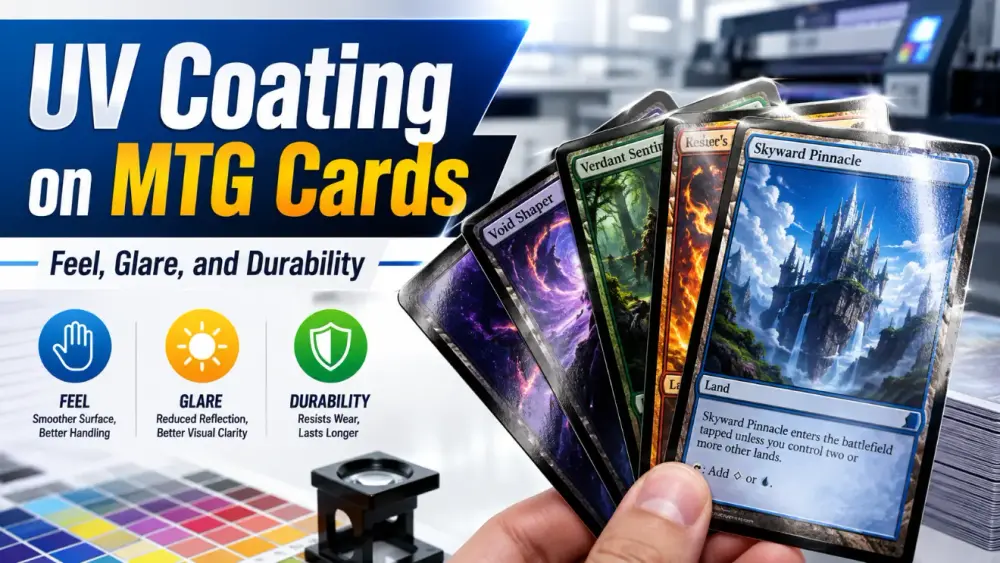
UV coating is a clear finish cured with ultraviolet light after printing. It changes the surface of a trading card more than the cardstock itself.
A good UV coating can make cards feel smoother and more finished while improving resistance to scratches, scuffs, fingerprints, and repeated handling.
Gloss UV increases shine and perceived color richness, but it also creates more glare under direct lighting.
Matte and satin UV coatings exist too, so "UV coated" does not automatically mean "glossy enough to signal aircraft."
For MTG proxies, cardstock, printing, coating, and cutting all matter. A fancy coating cannot rescue flimsy stock or a card cut three millimeters sideways.
A trading card can have beautiful artwork, crisp text, and excellent cardstock, then somehow still feel unfinished.
Usually, the surface is the culprit.
Searches for UV coating trading cards tend to focus on whether UV coating makes cards shinier. It does, depending on the coating. But that is only part of the story. UV coating also affects tactile feel, resistance to everyday handling, perceived color, glare, and how "finished" a printed card feels in your hand.
For MTG proxies, those little differences add up quickly. One card is a curiosity. A hundred cards are a deck, and suddenly every tiny production choice gets shuffled together.
What Is UV Coating on a Trading Card?
UV coating is a liquid coating applied over a printed surface and then cured using ultraviolet light.
The UV light rapidly hardens the coating into a finished surface. Commercial UV coaters can apply high-gloss, satin, or matte finishes, although high-gloss UV is probably what most people picture when they hear the term.
That distinction matters.
UV describes how the coating is cured, not necessarily how shiny the finished card must be.
Duplo, for example, specifies gloss, satin, and matte finishes on its commercial flood UV coating systems. UV coating suppliers also formulate different finishes and performance characteristics depending on the application.
For trading cards, a flood coating usually covers the printed face as a continuous surface rather than highlighting one particular area. Spot UV is different. Spot UV selectively coats individual artwork, text, logos, or graphic elements, usually for decorative contrast.
Trading cards generally benefit more from consistency than from turning the textbox into a tiny disco floor.
UV Coating Trading Cards: What Actually Changes?
Think about the finished card as a stack of decisions:
Cardstock determines most of the thickness, stiffness, and structural feel.
Printing determines image detail, color, text clarity, and registration.
UV coating changes the outer surface and adds protection.
Cutting determines the final dimensions, edges, and corners.
UV coating is important, but it is not magical shellac that fixes everything beneath it.
Put gorgeous UV coating on poor cardstock and you have shiny poor cardstock. Congratulations on the promotion.
Feel
A properly applied UV coating creates a more uniform finished surface over the printed sheet.
With a gloss formulation, that surface normally feels smoother and more polished than untreated printed cardstock. Depending on the formulation and coating weight, the card may also feel slightly slicker.
This is part of what people are describing when they say a professionally finished card feels different from something printed on an office printer.
The difference becomes particularly obvious when comparing:
plain cardstock
toner or ink directly on cardstock
coated commercial cardstock
coated cardstock with an additional UV finish
Each additional finishing step changes the surface.
That said, don't give UV coating too much credit for shuffle feel.
Once a card is inside a sleeve, the outside of the sleeve is doing most of the sliding against neighboring cards. Cardstock thickness, stiffness, dimensional consistency, and the sleeves themselves matter enormously.
UV coating is one part of the equation, not the entire equation wearing sunglasses.
Does UV Coating Make MTG Cards More Durable?
Yes, particularly at the printed surface.
Commercial UV coating systems are specifically marketed for improving resistance to scratching and scuffing. Coating manufacturers also formulate UV finishes for strong rub resistance, which is useful for something handled as frequently as a trading card.
That protection matters because printed cards have a surprisingly irritating life.
They get:
shuffled
pulled in and out of sleeves
stacked
slid across tables
handled with fingers
dropped
transported in deck boxes
subjected to the mysterious sticky table at game night that nobody is willing to explain
A cured coating creates a protective layer between much of that abuse and the printed image underneath.
But UV coating does not make a trading card indestructible.
What UV coating helps protect against
It is particularly useful for reducing:
surface scuffing
rubbing
light scratching
fingerprints and dirt contacting the printed surface
general print wear from repeated handling
What UV coating does not solve
It cannot eliminate:
bent corners
creases
severe gouges
water soaking into exposed paper edges
cardstock delamination
physical damage from aggressive shuffling
There is also an important manufacturing detail here.
In a coat-then-cut workflow, the large printed sheet receives its coating before the individual cards are cut out. That means the coating protects the faces, while final cutting exposes fresh cardstock along the card edge.
So edge quality still depends heavily on the cardstock and cutting process.
Finish matters. Cutting still gets to have a job.
What Does UV Coating Do to Color?
A glossy coating can make printed colors appear richer and more saturated.
The underlying CMYK values did not secretly level up. What changed is the way light interacts with the surface.
Duplo describes its flood UV coating equipment as enhancing the richness of printed colors, and this is one reason gloss coatings are common on commercial print pieces where artwork needs visual punch.
On an MTG card, that can make:
darker artwork look deeper
saturated colors appear richer
black areas look more substantial
contrast feel stronger
detailed artwork look cleaner at first glance
There is a limit.
Too much gloss does not automatically mean a better card. At some point you are just getting a better reflection of your ceiling fan.
The Tradeoff: UV Coating and Glare
This is probably the biggest downside of high-gloss UV coating.
Glossy surfaces reflect more direct light.
Under ordinary room lighting, the effect can be attractive. Tilt the card and highlights move across the artwork, giving the surface a clean, finished appearance.
Under strong overhead lighting, you can also hit an angle where part of the card becomes difficult to read.
Anyone who has played Magic beneath extremely enthusiastic LED fixtures knows the phenomenon.
High-gloss UV
Advantages:
strongest shine
colors can appear richer
very smooth finish
strong surface protection
Tradeoffs:
more glare
fingerprints can be more visible
may feel slicker than some players prefer
Satin UV
Satin sits between gloss and matte.
You get a finished surface and protection without the strongest mirror-like reflections.
For trading cards, this can be a very practical compromise.
Matte UV
Matte UV reduces reflected glare and gives the card a more subdued appearance.
The tradeoff is that colors may not have the same visual "pop" as a high-gloss treatment.
There is no universally correct finish. You are balancing visual richness, glare, tactile feel, and protection.
UV Coating vs. Lamination
These are sometimes lumped together because both sit on top of a printed sheet, but they are different finishing processes.
UV coating applies a liquid coating that is cured over the print.
Lamination applies a separate film to the printed material.
Lamination can create substantial protection and dramatically change tactile feel, but it also adds another physical film layer. Depending on the stock, film, and adhesive, that can change the finished card's thickness and stiffness more noticeably.
For trading cards, where fractions of overall thickness and consistency across an entire deck matter, those choices need to be considered together.
This is why card production should be treated as a system rather than a list of independent upgrades.
You cannot simply select "more premium" five times and assume physics will politely cooperate.
Why Coating Matters More on Professionally Printed Proxies
A quick homemade proxy may not need UV coating at all.
If you're testing whether your Commander deck actually needs another seven-mana creature, a paper print slipped into an opaque sleeve can answer that question perfectly well. Our guide to making homemade MTG proxy cards covers that approach.
But when you want a complete proxy card rather than a paper insert, surface finishing becomes more important.
Now the card itself needs to deliver:
sufficient stiffness
consistent thickness
crisp printed detail
durable surfaces
accurate dimensions
clean corners
a consistent feel from card to card
ProxyMTG's print-on-demand MTG proxy service uses premium black-core cardstock, UV coating, enhanced print files, and precision die cutting as parts of the same production workflow.
That last part is important.
The coating is not being asked to do everything.
Good, Better, Best: Thinking About Trading Card Finish
If you're comparing card production methods, this is the framework I would use.
Good: Printable and playable
Correct card dimensions
Readable artwork and text
Reasonably sturdy cardstock
Clean straight cuts
Sleeved for gameplay
Perfectly sufficient for quick testing.
Better: Consistent finished cards
Purpose-built cardstock
High-resolution commercial printing
Consistent color
Protective surface finish
Rounded corners
Accurate card dimensions
Now the card itself feels like a finished game component rather than a printout.
Best: Treat the entire production chain as one system
Cardstock selected for thickness and stiffness
Source artwork prepared for print
High-quality commercial press output
Controlled UV coating
Precise die cutting
Consistency checks across the run
The important word is consistent.
A deck containing 100 individually impressive cards that all have slightly different dimensions, thicknesses, and finishes is not premium. It is a science experiment.
Is More UV Coating Always Better?
No.
The goal is not to apply the thickest possible layer.
Coating volume, curing, substrate compatibility, and formulation all affect the result. Too much coating can produce a surface that feels inappropriate for the application, and poor coating control can create visible finishing defects.
For trading cards, consistency wins.
You want a controlled finish across:
the center of the sheet
the outer cards
light artwork
dark artwork
front and back surfaces, when both are coated
A predictable moderate finish is much more useful than chasing maximum gloss.
So, Is UV Coating Worth It for MTG Proxies?
For a professionally printed card, I believe it is.
The main reason is not simply shine. It is the combination of surface protection and finished tactile quality.
A good UV coat helps printed MTG proxies resist routine handling while giving the cardstock a smoother, more complete surface. When paired with good cardstock, accurate printing, and precise cutting, it contributes to the overall card feel people expect from a professionally produced game component.
If you're printing something at home for tonight, don't lose sleep over it.
If you're manufacturing hundreds or thousands of individual trading cards and expecting them all to feel consistent, suddenly coating stops being a decorative checkbox and becomes a production decision.
Cardboard is annoyingly demanding once you start taking it seriously.
FAQs
Does UV coating make trading cards waterproof?
No. UV coating provides surface protection, but it does not make an entire paper trading card waterproof. The edges, cuts, and any damaged areas can still expose the underlying paperboard to moisture.
Does UV coating make MTG cards thicker?
A coating adds material to the printed sheet, so technically it contributes to finished thickness. However, the cardstock remains the primary factor controlling overall card thickness and stiffness.
Is every UV coating glossy?
No. Commercial UV coaters can apply gloss, satin, and matte finishes. "UV" refers primarily to the curing process, not one mandatory sheen level.
Why do UV-coated cards sometimes have more glare?
Gloss UV creates a smooth reflective surface. When direct light hits the card at certain angles, more of that light is reflected toward your eyes. Matte and satin finishes reduce this effect.
Does UV coating improve shuffle feel?
Indirectly. UV coating changes the card's surface, but once cards are sleeved, the sleeve exterior controls most card-to-card friction. Cardstock thickness, stiffness, cutting consistency, and sleeve choice also matter heavily.
Can UV coating prevent scratched cards?
It improves resistance to scratches, scuffs, and rubbing, but it cannot prevent all physical damage. Deep scratches, creasing, corner impacts, and exposed-edge wear can still damage a card.
References
ProxyMTG, Print MTG Proxies, current production information covering black-core cardstock, UV coating, print enhancement, and precision die cutting.
Duplo USA, Ultra 300Ai/300A UV Coater, commercial flood UV coating specifications including gloss, satin, and matte finishes, color enhancement, and protection from scratches and scuffs.
Cork Industries, High Gloss Finish UV Coating, technical overview of UV overprint coatings including high gloss, rapid curing, flexibility, and rub resistance.
PrintMagic, Standard Business Card Printing, overview of UV coating as a high-gloss light-cured coating used to add shine and surface durability to printed cardstock.
Brinkman Press, Paper Information, comparison of print coatings including UV finishes, gloss levels, durability, and surface characteristics.