

TLDR
Most of the time, “which printing?” is an aesthetic choice. The rules come from Oracle text, not whatever a 1997 textbox was trying to say.
Names “collide” in three common ways: lots of reprints/variants, multi-name cards (split cards, double-faced cards), and “interchangeable names” (Universes Within re-skins).
If you want the lowest-drama outcome, pick the most readable frame, keep versions consistent, and when ordering proxies, choose something that is clearly not an authentic card.
Magic has been printing the same cards for decades, in a shocking variety of frames, foils, showcase treatments, promos, Secret Lairs, “oops all full-art,” and the occasional “this one is the same card but legally it has a different name” situation. So yes, MTG card printings explained is basically a public service at this point.
This post helps you choose the right version of a card when your decklist says one thing, your memory says another, and the internet shows you 47 options, so you can build and print what you actually meant.
Why MTG printings feel like a trick question
If you ask “Which printing of Sol Ring should I use?” you are not asking a rules question. You are asking a taste question. And taste questions are where Magic players become philosophers.
Most “name collisions” happen because:
The same card has many printings (same name, same game piece, different look).
Some cards have multiple names on one physical card (split cards, double-faced cards).
Some cards have “interchangeable names” indicators (a re-skin with a different name that points back to another printing).
The good news: you can get this right in under a minute once you know what actually matters.
MTG card printings explained: what counts as “the same card”
Here are the only three pillars you need. Everything else is vibes.
1) Oracle text is the rules text
The rules for a card come from its Oracle text (the up-to-date official wording), not necessarily what’s printed on an older physical copy. That’s why two printings can look different, read slightly different, and still be the same card in gameplay.
Practical takeaway: if you are ever staring at old templating and thinking “wait, does this even work,” check Oracle wording and move on with your life.
2) The name is how the game identifies the card
Magic uses names constantly: deck construction limits, “name a card” effects, copying, searching, and a million judge calls that start with “okay, what card are we talking about.”
Practical takeaway: when a decklist line is ambiguous, you fix it by being more specific about which named thing you meant (or which face, for multi-name cards).
3) Format legality is mostly about the card, not the art treatment
In most paper formats, if the card is legal, you can generally use any tournament-legal printing of that card. The exceptions are the weird ones you already suspect are weird (gold-bordered, silver-bordered/acorn-stamped, playtest cards, etc.). In casual Commander, your pod’s norms matter more than the set symbol.
Practical takeaway: don’t confuse “this printing exists” with “this printing is legal everywhere.” When it matters, verify the format rules and the specific event.
The three “name collision” scenarios you’ll actually run into

Scenario A: Same name, a pile of printings (the normal kind of chaos)
This is the classic: your decklist says Counterspell, and now you have to pick between retro frame, Mystical Archive, Secret Lair, promo foil, and the one with art that makes you feel like you’re being judged.
How to choose quickly:
If you want speed of play, pick the most readable frame and art.
If you play webcam or bright lighting, avoid glare-heavy choices.
If you are mixing real cards and proxies, consistency matters more than perfection (matching vibe beats mixing five different borders in one deck unless your deck theme is “yard sale”).
If you’re ordering print-on-demand proxies, this is also where you decide whether you want “classic-looking” or “obviously playtest.” If your goal is low drama, pick obvious.
If you want ProxyMTG-specific context on choosing versions for readability and gameplay, start with Print MTG Proxies.
Scenario B: One physical card, multiple names (split cards, MDFCs, and friends)
These are the cards that make decklist software sigh quietly and pick something “helpful.”
Common sub-cases:
Split cards (example: Fire // Ice). The card has two names. When something asks you to name it, you usually name one half, not “both in a trench coat.”
Modal double-faced cards (MDFCs) (example: a land on one side, spell on the other). Decklists typically refer to the front face name, even though gameplay includes both.
Transforming double-faced cards (werewolf-style). Again, decklists use the front face, but you care about both sides when playing.
How to avoid confusion:
In your decklist notes or order notes, include the exact card as your platform spells it, especially for split cards and DFCs.
If you are sleeving with opaque backs, MDFCs become much simpler (you stop telegraphing your topdeck like it’s a magic trick you didn’t rehearse).
Proxy-specific note: if you print MDFCs, make sure you have a clean, consistent plan for how your table will handle the back face. ProxyMTG’s general readability philosophy is covered in Magic design changes for proxy players.
Scenario C: Interchangeable names (Universes Within and certain re-skins)
This is the one that actually feels like a “names collide” problem, because the game is acknowledging that names can be linked.
Some cards have later printings with interchangeable names indicators that point to another printing via set code and collector number. These are effectively “this is that card, but wearing a different costume.”
What this means in practice:
Your decklist might contain one name while your card image search shows another name with the same rules text.
Your playgroup might recognize the old name (or the Universes Beyond name), while your deck app exports the Universes Within name (or vice versa).
If you are proxying, you should pick the version that reduces table confusion, not the one that makes you feel clever for remembering the lore.
Rule of thumb: if your pod is not fluent in the alt-name ecosystem, choose the name your group will instantly recognize, or be ready to say “it’s functionally the same as X” exactly once, then get on with the game.
The “pick a printing” decision tree that won’t ruin your evening
Use this order. It’s boring because it works.
Step 1: Are you choosing for a sanctioned event, or casual play?
Sanctioned event: you need authentic cards and tournament-legal versions. Proxies are generally not allowed except narrow judge-issued situations. (This is not legal advice. Event rules and store policies vary.)
Casual play / testing: choose for readability, consistency, and social clarity.
Step 2: Does the card have multiple faces or multiple names?
If yes, prioritize the version that:
clearly shows both faces (for DFCs), or
matches how your decklist platform exports the name (for split cards), and
is easy to identify at a glance (because “hold on, what is that again” is the true enemy of fun).
Step 3: Do you care more about clarity or aesthetics?
You can have both, but you usually pick one first.
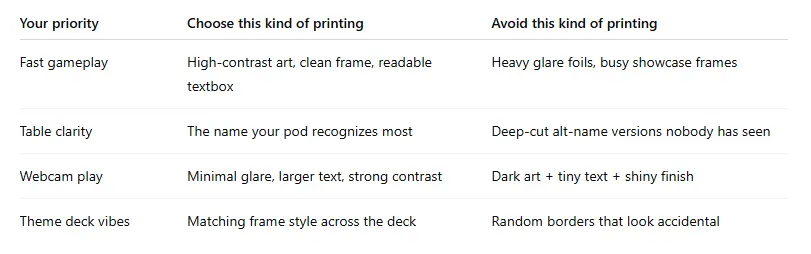
Step 4: If you need to be specific, specify like a grown-up
When you must disambiguate a printing (ordering, decklist export, sharing with friends), use identifiers that don’t rely on vibes:
Set code (like “MH2” or “SLD”) and collector number
A direct card database selection (many deck tools do this under the hood)
A screenshot or link in your group chat if you’re coordinating a shared cube or proxy list
If you want a quick mental model: the card name identifies the game piece, and set code plus collector number identifies the exact printing.
Proxy-friendly best practices for choosing versions
If you are printing proxies, you are not just choosing a look. You are choosing how much friction you want at the table.
Here’s the low-drama checklist:
Pick the most readable version first. Cool art is great. Reading your cards is better.
Keep your deck consistent. One border style across the deck feels intentional, five styles feels like you lost a bet.
Use sleeves that prevent marked cards issues, especially if you mix proxy and non-proxy.
Make proxies clearly not authentic. Custom backs and obvious markings reduce misunderstandings.
If a card has multiple faces, pick a solution you can execute every game without “wait, I need to resleeve.”
If you need boundaries on what’s allowed (and what we reject) for customization, ProxyMTG spells it out on our customization guidelines.

FAQs
Does it matter which edition of a card I play?
For gameplay, the Oracle text is what matters. For event legality, the format and tournament rules matter. For your friends’ patience, readability matters the most.
Why does my old card say something different than the online text?
Because Oracle wording gets updated over time to clarify rules, fix templating, or reflect modern mechanics language. Your cardboard is not wrong, it’s just historically accurate.
How do I handle split cards and double-faced cards in decklists?
Use the platform’s official naming, and when in doubt, be specific about the exact card you mean. For DFCs, assume your list will reference the front face name.
What are “interchangeable names” cards?
They are cards where a later printing can reference an original printing using an indicator. In practice, it’s a “this is that, but with a different name” situation, and the safest play is to choose the version your table will recognize instantly.
https://media.wizards.com/ContentResources/WPN/MTG_MTR_2025_Apr%2021_EN.pdf
https://media.wizards.com/2025/downloads/MagicCompRules%2020250725.pdf