
This post helps MTG Limited players decide which Lorwyn Eclipsed artifacts and lands to pick and play, so they can stop losing games to “my deck is fine, my mana is a crime.”
TLDR
Most ECL artifacts are typal glue, not generic power. They get way better once your creature-type count is real.
Fixing matters more than usual because vivid rewards you for having lots of colors among permanents, even if you are “mostly two colors.”
Shock lands are great, but they are still lands. Take them when you need consistency, not because you got emotionally attached to your opening hand.
Chronicle of Victory is the one that ends arguments. If you untap after casting it in the right deck, the game is usually over.
Table of Contents
Rating scale
Big picture: what artifacts and lands are doing in ECL
Artifacts: card-by-card ratings
Lands: fixing and when to take it
Draft shortcuts (rules of thumb)
FAQs
Artifacts and lands are the vegetables of Limited. Nobody shows up to Draft Night because they can’t wait to first-pick a land. And yet, this Lorwyn Eclipsed Limited artifacts and lands review exists because ECL is the kind of set where the “boring” cards quietly decide whether you get to cast your spells or stare at them like museum pieces.
ECL leans hard on typal play and “prismatic” payoffs. So the colorless section is doing more than filling packs. It is handing you the tools to be the correct kind of deck.
Lorwyn Eclipsed Limited Artifacts and Lands Review: The Rating Scale
I’m using a simple 0.0 to 5.0 Limited scale:
5.0: Ridiculous bomb. If you untap, the game usually ends.
4.0–4.5: Game-warping rare. Wins most games with minimal help.
3.0–3.5: Strong card you are happy to play. Often pulls you toward a lane.
2.0–2.5: Solid playable or role-player. Makes the deck, not the highlight reel.
1.0–1.5: Replacement-level filler or narrow synergy piece.
0.0–0.5: Actively bad in most decks. Sometimes a sideboard card. Mostly regret.
A rating assumes Draft or Sealed, normal gameplay, and that you are not doing a ten-minute dissertation at the table about how your “conceptual mana base” is actually fine.
Big picture: what artifacts and lands are doing in ECL
ECL’s limited identity (at least the part that matters for this article) is basically two questions:
Are you typal enough to turn on your payoffs?
Are you “colorful” enough for vivid without becoming five-color soup?
The set pushes classic Lorwyn creature types (Elves, Goblins, Kithkin, Merfolk, Faeries, Elementals, Giants, Treefolk) and also gives you tools like changeling and kindred to cheat your way into “counting.” That’s why multiple artifacts and the special land here ask you to choose a creature type.
On the other side, vivid cares about the number of colors among permanents you control. That can be real five-color mana. It can also be a two-color deck that incidentally turns on extra colors with hybrid cards or color-changing permanents. Either way, fixing lands and “add any color” artifacts quietly gain equity.
So your artifacts and lands are not generic. They are commitment detectors. If you’re not committed, they stare back at you.
Artifacts: card-by-card ratings
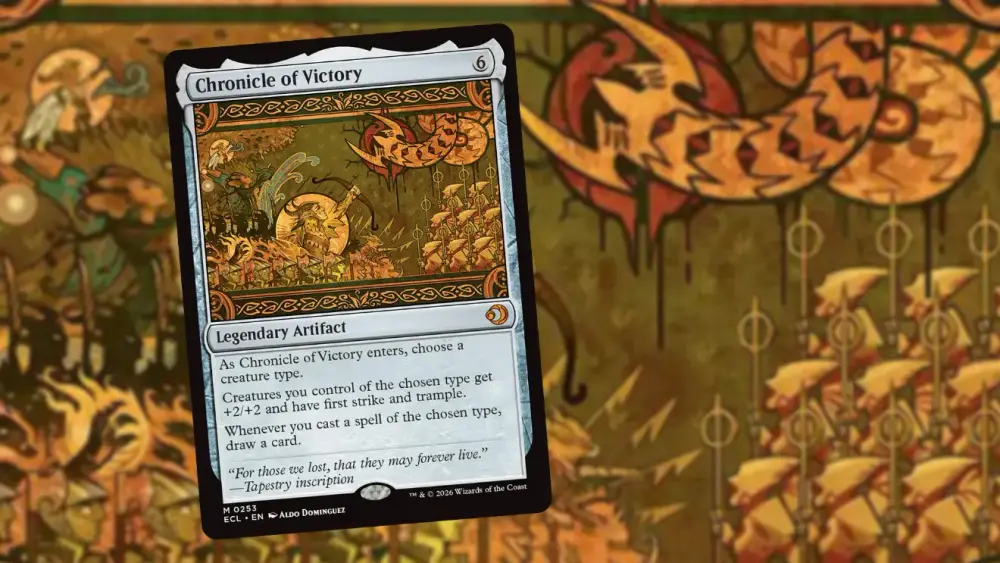
Chronicle of Victory
Rating: 4.5 / 5.0
Six mana is a lot. But so is “my entire team gets huge keywords and I draw cards for doing the thing my deck already wants to do.”
Chronicle of Victory is a typal finisher that also refuels you. The best version of this card is when:
your deck is dense with one creature type,
you have any board presence,
and you can afford a turn where your main action is “cast a six-drop and pray.”
If you untap, your attacks become horrifying. And the draw trigger means you don’t run out of gas while your opponent is trying to remember if “trample + first strike + +2/+2” is supposed to feel fair. (It is not.)
The only real knock is that it is slower than your average “oops I win” mythic. You need the right deck and at least a little time. Luckily, Limited is generous with time when both players are making complicated board states and pretending it’s “good gameplay.”
Dawn-Blessed Pennant
Rating: 1.5 / 5.0
Pennant looks like it wants to be an engine. In practice it is a small life drip plus a one-shot recursion button, locked behind typal setup.
If you’re deep in one tribe and games are grindy, the “return a card of the chosen type” activation can matter. Getting back your best creature (or your best removal-on-a-stick) is real.
But most of the time, Pennant is:
not affecting combat,
not fixing mana,
and not giving you tempo.
So you are spending a card slot on “eventual value” in a format where your opponent might simply curve out and ask you why you are holding a decorative banner instead of a creature.
Playable in slow typal decks. Easy cut in everything else.
Firdoch Core
Rating: 2.5 / 5.0
A three-mana mana rock in Limited is usually “fine, I guess.” Firdoch Core is a little better because:
it taps for any color,
and it has changeling, which matters in ECL more than you think,
and late game it can become a 4/4 if you have nothing else going on.
It is still a three-mana artifact that does not block on turn three unless you spend four more mana. So do not pretend it is a stabilizer.
Where it shines:
Sealed decks with awkward pools,
any build flirting with a splash,
vivid payoffs that want you to “accidentally” be more colorful,
typal decks that benefit from “this is every type” for behold or other checks.
It is not exciting. It is useful. Those are different things, and Limited punishes you when you confuse them.
Foraging Wickermaw
Rating: 3.0 / 5.0
Wickermaw is the kind of card that looks like filler until you play with it and realize it keeps solving small problems.
You get:
a 1/3 body that holds the ground,
a little selection with surveil 1,
and repeatable color fixing.
Yes, the fixing costs mana, and yes it is only once each turn. Still, the flexibility is real. It helps you cast your off-color card. It helps you turn on vivid by becoming a color. It helps you smooth draws when your deck is doing the classic Limited move of drawing the wrong half.
This is the kind of card that makes your deck feel like it has fewer “non-games.” That’s a compliment. It means you get to lose because of your decisions instead.
Gathering Stone
Rating: 3.5 / 5.0 (in the right deck), 1.0 / 5.0 (in the wrong one)
Gathering Stone is a typal card that demands you actually be typal. No vibes, no “I have seven Goblins and a dream.” It wants density.
When it is on, it does two very important things:
it makes your chosen-type spells cheaper,
and it repeatedly checks the top of your library for that type, drawing it if it hits, or binning it if you want.
That is card advantage plus cost reduction. In Limited, that’s how you bury people who are drawing one card a turn like it’s 2003.
The downside is simple: if you are not heavy on the chosen creature type, it becomes a four-mana artifact that mostly watches you miss. That is not a strategy. That is an autobiography titled “I Thought I Was the Merfolk Deck.”
Draft it when you’re already committed and your creature count supports it. Do not force it early unless you like hard mode.
Mirrormind Crown
Rating: 2.0 / 5.0 (build-around), 0.5 / 5.0 (most decks)
This is a rare that reads like it wants to do something illegal with tokens. And it can. The first time you would make tokens each turn, you can instead make that many copies of the equipped creature.
If you have:
consistent token production,
and a creature worth copying,
and time to pay 4 to cast plus 2 to equip,
then Mirrormind Crown can take over.
If you do not have those things, it is a slow equipment that does not help you live through the part of the game where you are being attacked by creatures.
Treat it as a build-around. It is not “good by default,” and that is fine. Not every rare has to save you from your own draft.
Puca’s Eye
Rating: 2.5 / 5.0 (if you can turn it on), 1.5 / 5.0 (if you can’t)
Puca’s Eye is quietly one of the more interesting “vivid support” pieces because it helps on two axes:
it replaces itself immediately (draw a card),
and it becomes a chosen color, which can help you reach five colors among permanents.
The activated ability (pay 3, tap to draw) is slow, but repeatable card draw wins long games. The catch is that you only get it if you have five colors among permanents you control.
In ECL, that condition is plausible, but not free. Two-color decks can sometimes get there via hybrid cards and color-changing effects. Three-color decks get there more naturally. Five-color decks, obviously, get there and then still sometimes lose because they drew the wrong lands. Balance is beautiful.
If your deck has vivid payoffs or a realistic plan to be “colorful,” Puca’s Eye is a solid role-player. If your deck is streamlined aggro, it’s a two-mana cantrip that asks you to spend future turns doing nothing. Your opponent says thank you.
Springleaf Drum
Rating: 2.5 / 5.0
One mana. Fixes any color. Requires a creature to tap.
This is a classic “quietly strong” card when your deck is:
creature-dense,
producing tokens,
or trying to splash without wrecking its land count.
The big upside is tempo. Drum can fix early and let you cast off-color spells without waiting to naturally draw the right land. The big downside is that it ties up your creatures. Tapping a creature to make mana is often correct, but it means that creature is not attacking or blocking. Sometimes that matters.
In ECL specifically, it gets extra credit because:
typal decks are creature-heavy,
and vivid sometimes rewards you for stretching,
and you might be playing creatures you do not mind tapping (small tokens, utility bodies).
Take it as a role-player, not a priority. You don’t want two of these unless your deck is built for it. You also don’t want zero if your mana is a mess and you’re pretending it isn’t.
Stalactite Dagger
Rating: 2.0 / 5.0
This equipment does three things:
it brings a 1/1 changeling token with it,
it gives +1/+1,
and it makes the equipped creature all creature types.
That is a lot of text for a card that still asks you to pay 2 to equip.
The changeling token matters more than the buff. It can turn on typal checks, enable convoke-style play, provide a body for sacrifice, or just chump block while you stabilize. The “equipped creature is all types” clause is also real in ECL, because it can turn random creatures into “counts as my tribe” for your other payoffs.
The problem is opportunity cost. Equipment that does not meaningfully change combat can be a trap if the format is fast. This one is playable, but it wants you to be in the lane where typal synergies matter and games go past turn six.
Lands: fixing and when to take it
Shock lands (Hallowed Fountain, Blood Crypt, Overgrown Tomb, Steam Vents, Temple Garden)
Rating: 3.0 / 5.0
Dual lands are good. Shock lands are better because they give you the option to enter untapped, at the cost of 2 life.
In Limited, the “2 life” part is not trivial, but it is also not scary. Life is a resource, and the point of resources is to spend them on doing things. Like casting your spells.
These lands:
make splashes realistic,
smooth awkward hands,
let you keep more openers,
and make your deck function like it was built by an adult.
Drafting advice: you do not need to slam these over premium playables. But you should take them over medium filler, especially once you know your colors or you’re clearly heading toward a vivid-friendly build.
Eclipsed Realms
Rating: 2.0 / 5.0 (typal deck), 0.5 / 5.0 (non-typal deck)
Eclipsed Realms is the land version of “commitment detector.”
It always taps for colorless. It can tap for any color, but only to cast spells of the chosen creature type or activate abilities of sources of that type.
In a deck that is heavily one of the supported tribes, that restriction is fine. Most of your creatures are on-type, your payoffs are on-type, and you are thrilled to have flexible mana.
In a deck that is not deeply typal, this land will betray you at the worst possible time. It will sit there making colorless while you stare at a removal spell you cannot cast. Then you will die, and the land will remain on the battlefield, innocent and smug.
Play it when your deck is mostly the chosen type and you care about fixing. Skip it otherwise.
Evolving Wilds
Rating: 2.5 / 5.0
Evolving Wilds is the dependable friend who always shows up, helps you move, and never asks you to explain your deck choices.
It fixes any color by fetching a basic. The cost is tempo, because the land comes in tapped and you spend the Wilds itself.
In ECL, Wilds is especially valuable if:
you are splashing,
you have vivid payoffs that care about colors,
you need to support multiple double-pip spells,
or you just want fewer non-games.
You can cut it in very aggressive decks where every tapped land is a small tragedy. Otherwise, play it and move on.
Draft shortcuts: when to take the boring card
Here are a few rules of thumb that keep you out of trouble:
1) Count your tribe before you take the tribe payoffs.
Gathering Stone wants you to be heavily on one type.
Chronicle of Victory also wants density, but it can carry harder because it is a finisher.
A simple check: if you cannot realistically hit 12+ creatures of that type, your typal engine pieces get much worse.
2) Fixing is a pick, not a consolation prize.
If your deck needs fixing, take it while the pack still has options. Waiting until the end of the draft to “solve mana” is how you end up playing Firdoch Core, Eclipsed Realms, and three off-color cards you refuse to cut because they are “too good.” That is not deckbuilding. That is denial.
3) Vivid is not permission to become five colors.
It is permission to be a little weird. Two colors plus a splash plus some hybrid cards plus a color-changing permanent can be enough. The prerelease guide basically calls out that you can increase colors without dramatically changing your deck. Use that as a hint, not a dare.
4) Slow artifacts need a reason.
If you are putting Puca’s Eye into your deck, you want a game plan that goes long and can turn it on. If you are putting Mirrormind Crown in, you want token production and a payoff creature. If you do not have a reason, the artifact is just occupying a slot that could have been a creature that blocks.
5) If you are practicing Limited or building an ECL cube, proxies are your friend.
Testing archetypes, tuning curves, and swapping in the right lands is exactly what proxies are for. Just keep the usual boundary: sanctioned events require authentic cards (with rare judge-issued exceptions). Casual play is where you can iterate freely.
Related reading on ProxyMTG
The History of MTG Proxies: From Playtesting to Modern Collectibles
MTG Card Printings Explained: Choosing the Right Version When Names Collide
FAQs
Are shock lands worth taking early in ECL draft?
They are worth taking over filler and medium playables, especially once your colors are known. Over premium removal or a strong creature, usually not, unless your deck’s mana is already screaming for help.
How many on-type creatures do I need for Gathering Stone?
As a rule, you want around 12+ of the chosen type to feel good about it. The more you have, the closer it becomes to “engine” instead of “expensive rock that whiffs.”
Is Eclipsed Realms playable if I’m only partially typal?
Sometimes, but it gets risky fast. If it cannot cast your non-typal interaction or key off-tribe spells, it becomes a colorless land at the worst possible time.
Can Puca’s Eye actually turn on in a two-color deck?
It can, depending on how many hybrid cards and color-changing effects you have, plus any off-color permanents you can reasonably play. If you cannot picture it happening consistently by midgame, treat it as a two-mana cantrip with no upside.
What’s the safest “fix my mana” package in ECL Sealed?
Start with your best two colors, then add Evolving Wilds, a shock land if it matches, and a fixer like Foraging Wickermaw or Firdoch Core if you’re splashing or chasing vivid payoffs.